A carton overwrapping machine wraps rigid folding cartons in 18 to 40 μm heat-sealable BOPP or cellulose film, folding tight envelope end-folds and sealing bottom lap and side seams at 100 to 125 °C within plus or minus 1 °C. That direct-contact thermal process delivers glossy, tamper-evident shisha boxes with tear tape while preventing print scorching.
Getting clean, wrinkle-free corners on printed molasses tobacco cartons depends on matching four variables together: heat-set film chemistry, sealing-plate temperature control, paperboard rigidity, and format changeover tooling. Use this engineering breakdown alongside our automated shisha tobacco packaging line overview and BOPP film properties guide before locking down carton dielines and RFQ specifications.
How Does a Carton Overwrapping Machine Form Envelope End-Folds and Lap Seals?
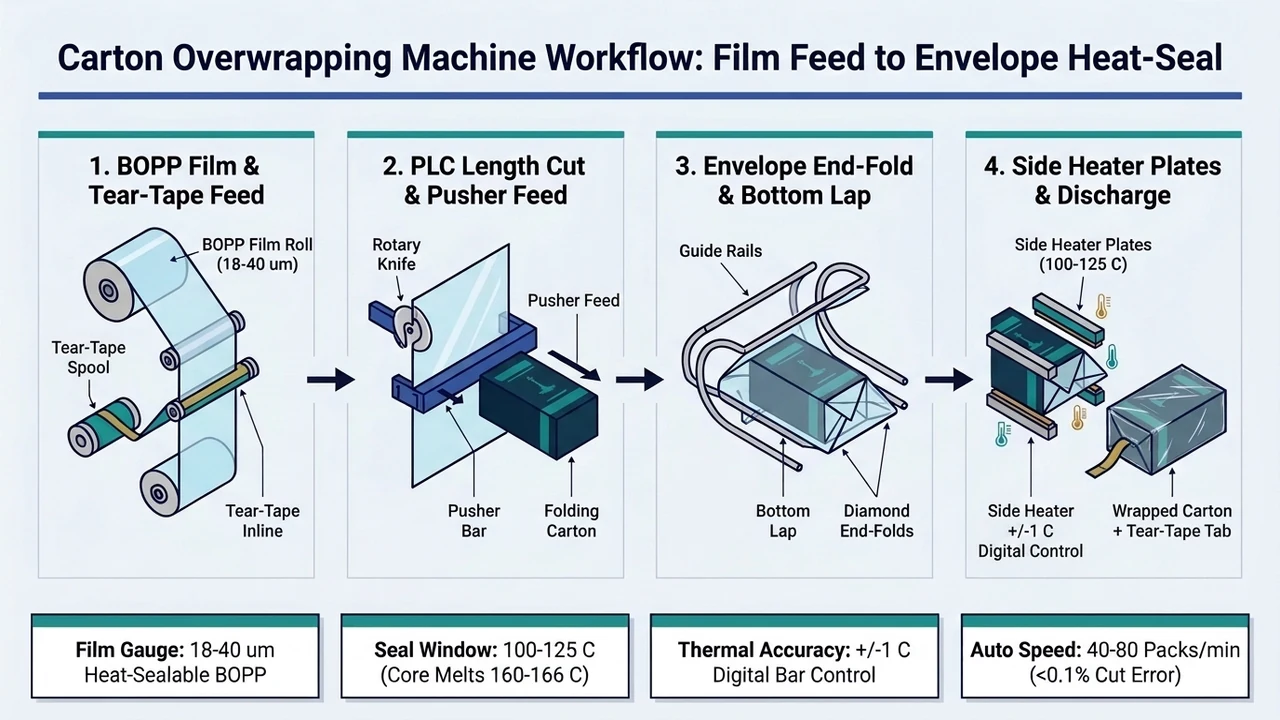
A carton overwrapping machine uses a PLC and photoelectric sensors to unwind and cut a precise sheet of BOPP or cellophane film, push the rigid folding carton through the film curtain to create a bottom lap seal, tuck triangular envelope flaps along both carton ends, and weld overlapping copolymer skins via Teflon-coated hot plates held at 100 to 125 °C.
Film Unwind, Tear-Tape Placement, and PLC Sheet Cutting
In an automated overwrapper, a programmable logic controller (PLC) and optical sensors synchronize roll-film unwind with rotary cutting so every sheet matches the exact carton girth plus end-fold allowance. High-speed commercial cellophane overwrapping machines sustain dimension and cutting error below 0.1% across continuous runs, keeping fold symmetry uniform across every printed box.
Before the sheet is cut, an inline applicator bonds a narrow strip of easy-open tear tape directly onto the film web. Pulling the exposed tab slices a clean, controlled path through the overwrap without scissors or knives. Tobacco and retail carton lines rely on polypropylene-based BOPP tear tape for clear appearance, straight tearing, and strong tensile performance, often loading 10,000 to 100,000 meter spools to minimize roll-change stops.
Bottom Lap Sealing, Envelope Folding, and Anti-Scorch Controls
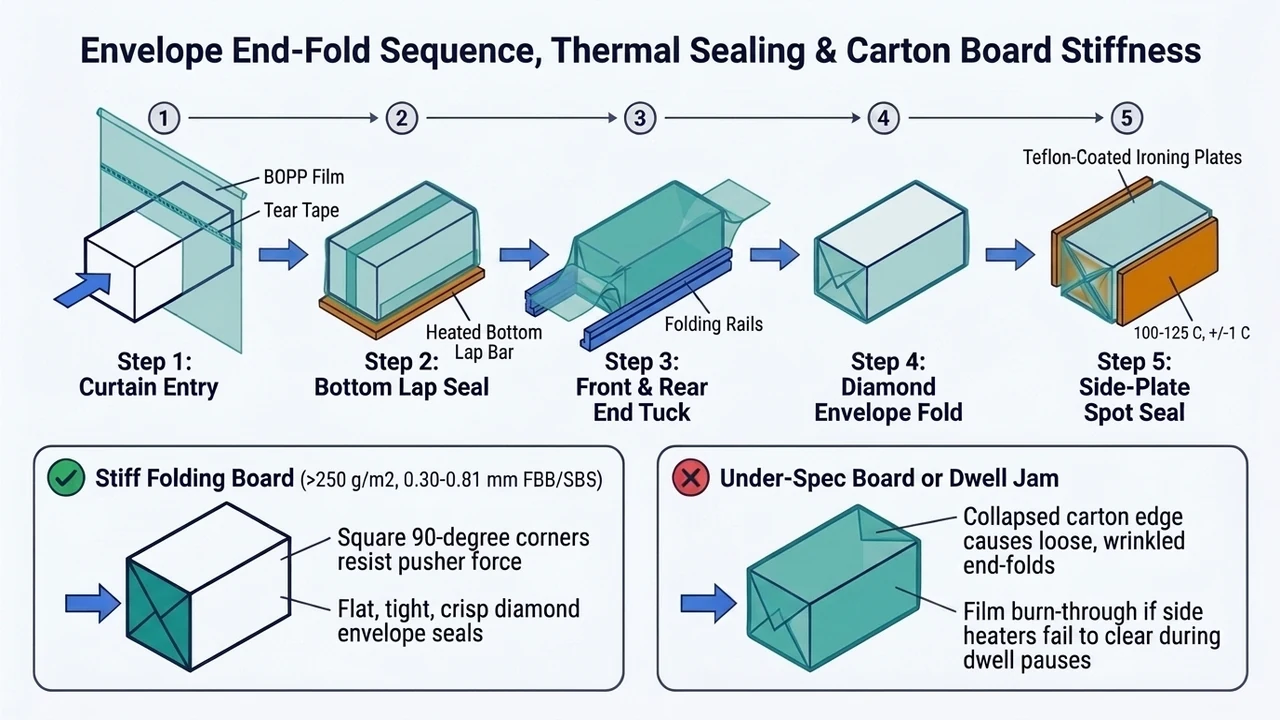
Once cut, a horizontal pusher drives the rigid rectangular carton through the suspended film curtain so the web wraps tightly around four faces and overlaps underneath to form a longitudinal bottom lap seal. Fixed and cam-driven folding rails then tuck the open film extensions against both carton ends in a tight diamond envelope fold—delivering controlled film tension and hermetic envelope-style sealing in a compact machine footprint.
As documented in Wikipedia’s heat sealer reference, direct-contact hot bar sealers maintain heated bars, irons, or dies at a constant temperature to fuse thermoplastic interfaces, often using slick release surfaces such as Teflon films to stop molten polymer from sticking to hot tooling. Good seals depend strictly on balancing time, temperature, and pressure across clean film surfaces.
Two thermal boundaries prevent print scorching and film burn-through on decorated shisha boxes:
- Seal skin vs. core melting separation: Commercial isotactic polypropylene melts between 160 and 166 °C (320 to 331 °F), as noted in Wikipedia’s polypropylene reference. Clear glossy heat-sealable BOPP overwrap grades (18 to 40 μm) carry low-temperature copolymer skins that initiate seals at 100 to 125 °C while the oriented core remains flat and dimensionally stable.
- Tight digital heater control: Specifying digital temperature controllers that hold sealing bar accuracy within plus or minus 1 °C avoids localized film burning or heat wrinkles across printed cartons. During low-speed pauses or conveyor jams, clearing heated side plates away from stationary cartons prevents excess dwell time from melting through the outer wrap or blistering carton varnish.
| Overwrapping Stage | Mechanical & Control Function | Verified Engineering Benchmark | Primary Quality Role |
|---|---|---|---|
| Film & tear-tape unwind | Constant-tension web feed with inline BOPP tear-tape strip | 18–40 μm heat-sealable BOPP; 10,000–100,000 m tear-tape spools | Clean tool-free opening with minimal splice stops |
| PLC cutting & pusher feed | Sensor-timed rotary knife and horizontal carton pusher | Cutting and dimension error below 0.1% on PLC automatic units | Uniform end-fold overhang without skewed graphics |
| Bottom lap & envelope fold | Wrap tube, heated bottom bar, and mechanical end-tuck rails | Tight diamond envelope folding around rigid rectangular cartons | Flush gift-wrap finish without loose film ears |
| Side-plate heat sealing | Constant-heat Teflon-coated ironing plates on end overlaps | 100–125 °C seal initiation; ±1 °C digital controller accuracy | Hermetic end seals below 160–166 °C PP core melt |
When Should You Choose a Small Semi-Automatic vs. Automatic Carton Overwrapping Machine?
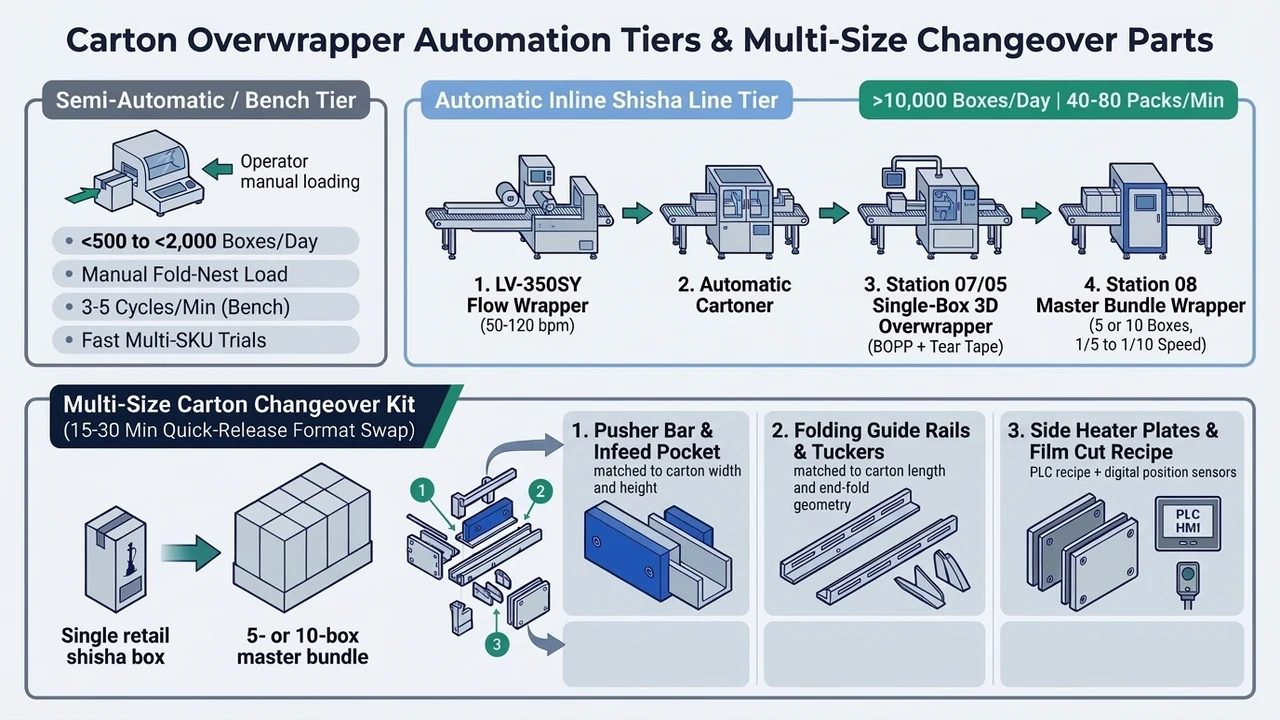
Choose a small semi-automatic carton overwrapping machine when daily output stays under 500 to 2,000 boxes or when frequent pilot runs demand fast hand-loaded flexibility; move to a PLC-controlled automatic overwrapper running 40 to 80 packs/min once volume exceeds 10,000 cartons/day or when linking directly downstream of a high-speed shisha cartoner.
Daily Volume Thresholds and Small-Batch Flexibility
Start-ups, laboratory trials, and craft shisha facilities producing fewer than 500 units per day—and low-volume packaging rooms running below 2,000 boxes per day—gain the highest floor-space and capital efficiency from semi-automatic machines. Operators load individual cartons or small bundles into fold nests manually before the heated plates complete the seal; manual bench heat-sealing units complete 3 to 5 wrap cycles per minute.
Once daily demand crosses 10,000 packaged cartons, manual loading becomes an immediate labor bottleneck and seal consistency drifts across long shifts. Fully automatic cellophane overwrapping machines automate film feeding, cutting, folding, and sealing at 40 to 80 packs per minute. When sizing an automatic model for seasonal demand spikes, leave a 20% operational cushion below maximum rated speed so the wrapper handles surge runs without overheating sealing bars or starving downstream case packing.
Balancing Inline Shisha Packaging Lines (Single-Box vs. Master Bundles)
On an integrated shisha tobacco packaging line, secondary carton overwrapping operates across dedicated line positions depending on layout topology:
- Individual retail box overwrapping: Station 07 on our Straight-Line layout—or Station 05 on the compact Corner-Type layout—wraps every printed folding carton in clear BOPP/cellophane film with envelope-folded corners and an integrated tear-off tape strip.
- Master bundle overwrapping: Station 08 on the Straight-Line layout collates multiple wrapped retail boxes—such as 5 or 10 cartons per bundle—and applies a tight outer 3D film wrap ready for shipping cases. Because each master bundle groups 5 or 10 retail cartons, Station 08 only needs to cycle at 1/5th to 1/10th the speed of Station 07.
Because a standalone LV-350SY horizontal flow wrapper is rated at 50 to 120 bags/min, line engineers must pace upstream pillow wrapping and cartoning to match the downstream 3D overwrapper cycle rate. Realistic shift modeling applies a 70 to 80% Overall Equipment Effectiveness (OEE) factor and budgets 5 to 10 minutes per BOPP film and tear-tape splice, as detailed in our shisha packaging line capacity guide.
| Selection Parameter | Manual Bench / Semi-Automatic | Fully Automatic Single-Box Wrapper | Inline Master Bundle Overwrapper |
|---|---|---|---|
| Daily output threshold | Under 500 to under 2,000 boxes/day | Over 10,000 cartons/day | Multi-pack collation behind Station 07 |
| Rated speed benchmark | 3–5 wrap cycles/min (bench units) | 40–80 packs/min (with 20% cushion) | 1/5th to 1/10th of single-box rate |
| Film & feeding control | Operator loads cartons into fold nests | PLC + sensors (<0.1% cut error) | Automated 5- or 10-box collator |
| Shisha line station role | Standalone craft runs & market trials | Station 07 (Straight) / Station 05 (Corner) | Station 08 (Straight-Line bundles) |
| Shift planning allowances | Labor-paced loading & manual stops | 70–80% OEE; 5–10 min BOPP/tape splice | Synchronized to upstream single-box flow |
Why Overwrap a Folding Carton Instead of Leaving It Bare or Using Shrink Wrap?
Overwrapping a printed folding carton with heat-set BOPP film adds tamper-evident security, odor containment, grease and moisture resistance, scuff protection, and clean multi-pack bundling—without passing heat-sensitive molasses tobacco through a high-temperature shrink tunnel or leaving bare paperboard vulnerable to retail pilferage.
Tamper Evidence, Aroma Control, and Shelf Protection
As summarized in Wikipedia’s overwrap engineering entry, applying a plastic film overwrap over a primary or secondary retail container delivers six practical protective functions: keeping cartons clean, deterring pilferage or premature opening, providing tamper-indicating and authentication seals, excluding insects, supplying grease and water resistance, and providing odor control by preventing odor leakage and cross-contamination across adjacent flavors. Overwrapping also combines two or more smaller boxes into rigid wholesale multi-packs.
Although tobacco cartons are not over-the-counter drugs, the U.S. Food and Drug Administration’s tamper-evident packaging standard in 21 CFR 211.132 defines the benchmark principle used across regulated retail packaging: a tamper-evident barrier over a secondary carton provides visible evidence if breached or missing and must remain intact during reasonable handling across manufacture, distribution, and retail display. Once a consumer pulls the embedded tear tape, the broken film cannot be invisibly restored.
Heat-Set BOPP Overwrap vs. Regenerated Cellophane and Shrink Wrap
Packaging buyers often compare envelope overwrapping against shrink wrap or true cellophane film. Wikipedia’s shrink wrap reference highlights the fundamental mechanical difference: shrink films—most commonly polyethylene—are heated with a heat gun or sent through a heat tunnel so the oriented polymer shrinks tightly around the box, whereas tenterframe heat-set BOPP is reheated in a constrained state during manufacturing so its shrink properties are destroyed. Eliminating the shrink tunnel prevents warped carton panels, softened molasses inner packs, and dog-eared plastic corners.
True regenerated cellulose cellophane, documented in Wikipedia’s cellophane reference, is biosourced, compostable, and biodegradable, yet remains highly permeable to water vapor unless coated with nitrocellulose lacquer. That vapor breathability suits cigars that benefit from air and moisture exchange in storage, whereas mainstream carton overwrapping shifted heavily toward lower-cost petrochemical BOPP and BoPET during the 1980s and 1990s. Polypropylene’s low density of 0.895 to 0.93 g/cm also maximizes film yield per kilogram of roll stock, though cold-chain shippers should remember polypropylene turns brittle below 0 °C.
| Outer Protection Method | Film / Board Chemistry | Thermal Exposure & Optics | Moisture, Odor & Security Performance | Best Shisha Carton Role |
|---|---|---|---|---|
| Heat-set BOPP envelope overwrap | 18–40 μm oriented PP (0.895–0.93 g/cm) + copolymer seal skin | Localized 100–125 °C plate seal; crisp flat glossy envelope folds | Strong water/grease barrier, odor control, clear tamper evidence + tear tape | Standard retail shisha boxes and 5- or 10-box bundles |
| Regenerated cellulose cellophane | Wood/cotton cellulose sheet (nitrocellulose coat optional) | Non-melting cellulose base; crisp dead-fold clarity | High water-vapor permeability unless lacquered; biosourced and compostable | Specialty compostable programs or breathable cigar packs |
| Polyethylene shrink wrap | Oriented polyethylene shrink film | Requires heat gun or shrink tunnel to shrink film tightly | Good unitizing and dust cover, but tunnel heat risks softening sticky packs | Bulk transit cases or irregular tray bundles |
| Bare printed folding carton | Unwrapped FBB or SBS paperboard | No sealing heat applied; matte or varnished board exposed | No tamper-evident outer barrier; vulnerable to scuffing, grease, and odor cross-talk | Manual low-security local distribution only |
How Do Carton Board Stiffness, Square Corners, and Seal Testing Affect Wrapping Quality?
Carton overwrapping machines rely on rigid, squarely creased paperboard above 250 g/m² and 0.30 mm caliper (up to the 0.81 mm cutting limit) to resist pusher compression during folding; validating board machinability, testing film seams under ASTM peel and leak standards, and guarding moving pushers and hot bars prevent crushed edges, loose seals, and operator burns.
Paperboard Caliper, FBB/SBS Grades, and Corner Squareness
Unlike flexible pouches, an envelope overwrapper uses the carton itself as the internal forming mandrel. As detailed in Wikipedia’s paperboard reference, ISO standards define paperboard as paper with a grammage above 250 g/m², and commercial board generally exceeds 0.30 mm (0.012 in or 12 points) in thickness to deliver foldability and rigidity. Two grades dominate high-speed retail cartons: folding boxboard (FBB), engineered to bend cleanly along scored creases without cracking, and solid bleached sulphate (SBS / SBB), a clean white virgin board favored for sharp retail graphics.
At the upper thickness boundary, Wikipedia’s folding carton reference notes that die-cutting machinery limits folding carton board thickness to 0.81 mm (0.032 in), and cartons must be engineered for compatibility with downstream cartoners and conveyors—verified through simulation or experimental process capability studies. When buyers downgrade to thin, low-stiffness board or poorly glued flaps, horizontal pusher force bows the leading panel inward, creating bowed edges that leave diamond end-folds loose and unsealed against the side heater plates.
Quantitative Seal Validation and Machine Guarding Safety
During machine commissioning and routine quality checks, verifying heat-seal consistency goes beyond visual inspection. Standard quantitative methods include:
- Seal strength peel testing (ASTM F88 and F2824): Measures bond strength and consistency across flexible barrier seams as well as controlled opening force for process validation and capability tracking.
- Burst, creep, and leak testing (ASTM F1140, F2054, and D3078): Evaluates pressurized burst failure points, extended creep hold at roughly 80% of minimum burst pressure, and submerged vacuum dye penetration to detect micro-pinholes or cold spots in folded overlaps.
Finally, overwrapping machines combine reciprocating carton pushers, rotary film knives, and constantly heated metal sealing plates. As emphasized in OSHA’s machine guarding overview, moving machine parts can cause severe workplace injuries including crushed fingers or hands, amputations, burns, or blindness, so any hazardous mechanism, pinch point, or heated sealing surface must be physically safeguarded with interlocked guards before production starts.
What Drives Carton Overwrapping Machine Cost and Multi-Size Changeover Scope?
Carton overwrapping machine investment scales with four engineering variables rather than headline speed alone: semi-automatic versus PLC-controlled automatic architecture, dedicated single-format tooling versus modular quick-release multi-SKU change parts (15 to 30 minute swaps), single-box versus multi-box bundle stations, and full-line FAT and spare-parts scope.
Single-Format Dedicated Frames vs. Multi-Size Quick-Changeover Kits
If a shisha plant packages one standard retail box year-round, a dedicated single-format overwrapper delivers the simplest mechanical linkage and lowest upkeep cost. By contrast, brands switching regularly across multiple retail gram weights—or converting between individual cartons and 5- or 10-box wholesale bundles—need modular quick-formatting architecture.
Switching box length, width, and height requires changing matched sets of carton molds and mechanical contact parts: the infeed pusher bar, folding guide rails and tuckers, and side-seal heater plates, paired with updated film-cut length settings. Modern multi-format machines integrate quick-release folding assemblies, digital position sensors, and pre-configured PLC recipes so trained operators complete full size-part formatting in 15 to 30 minutes instead of spending half a shift re-shimming mechanical cams.
RFQ Audit Checklist Before Approving a Quotation
To compare proposals apples-to-apples—and align budgets with our shisha packing machine price and cost drivers guide—itemize every technical scope item before requesting factory drawings:
| RFQ & Changeover Item | Specification to Confirm with Supplier | Operational & Budget Impact |
|---|---|---|
| Carton dimensions (L × W × H) | Minimum and maximum retail box plus 5- or 10-box bundle sizes | Sets frame envelope and number of carton mold change-part sets |
| Paperboard grade & caliper | Board type (FBB or SBS), grammage (>250 g/m²), and thickness (0.30–0.81 mm) | Ensures square corners survive pusher feed without collapsing |
| Overwrap film & tear tape | 18–40 μm heat-sealable BOPP (100–125 °C seal) and 10,000–100,000 m BOPP tape | Locks roll core dimensions, tension control, and splice intervals |
| Throughput & automation tier | Semi-auto (<2,000/day) vs. PLC auto (40–80 packs/min + 20% cushion) | Balances downstream speed against upstream LV-350SY flow wrapper |
| Tooling changeover hardware | Dedicated single-size tooling vs. 15–30 min quick-release kits + digital sensors | Determines downtime across multi-SKU flavor and box-size shifts |
| FAT & after-sales package | Connected FAT running actual cartons/BOPP film plus 12-month wear-parts kit | Verifies real seal quality before shipment and prevents line stops |
Always require integrated Factory Acceptance Testing (FAT) running the connected line with your actual inner film, printed folding cartons, and BOPP overwrap rolls, and confirm a 12-month wear-parts kit and commissioning plan through installation and after-sales support before shipment.
Frequently Asked Questions
What film thickness and sealing temperature work best on a carton overwrapping machine?
Commercial carton overwrapping machines run 18 to 40 μm heat-sealable BOPP film coated with copolymer skins that seal at 100 to 125 °C—well below commercial isotactic polypropylene’s 160 to 166 °C melting point. Pairing that window with Teflon-coated hot plates and plus or minus 1 °C digital temperature control keeps folds flat without scorching carton ink.
When is a small semi-automatic carton overwrapper better than a fully automatic machine?
A semi-automatic overwrapper fits start-ups, labs, and plants producing fewer than 500 to 2,000 boxes per day where operators can hand-load multiple box sizes into fold nests (with manual bench sealers running 3 to 5 cycles per minute). Once daily output exceeds 10,000 boxes, a PLC-controlled automatic machine running 40 to 80 packs per minute becomes essential.
How long does it take to switch box sizes on a multi-SKU carton overwrapping machine?
Single-format plants save complexity with dedicated tooling, while multi-SKU facilities using modular quick-release folding assemblies, digital position sensors, and pre-configured PLC recipes complete full size-part changeovers—swapping pushers, folding rails, and side heater plates—in 15 to 30 minutes.
Why does low-grammage paperboard cause loose envelope folds on an overwrapper?
Because the carton itself acts as the forming support during wrapping, paperboard should meet ISO paperboard thresholds above 250 g/m² and over 0.30 mm caliper (such as FBB or SBS up to the 0.81 mm cutting limit). Thin, flexible board collapses under horizontal pusher pressure, leaving bowed corners that prevent side heating plates from sealing the diamond flaps flush.
Can one automatic shisha line wrap both individual retail boxes and 10-box bundles?
Yes, by assigning dedicated downstream stations: on an 8-station Straight-Line shisha packaging line, Station 07 wraps individual retail cartons with BOPP film and tear tape, while Station 08 collates 5 or 10 wrapped boxes into a tight 3D master bundle cycling at 1/5th to 1/10th the single-box speed.
Sources
- Wikipedia — Overwrap (Plastic Film Wrapping, Heat Seals, Tamper Indication, Odor Control, and Shrink vs. Overwrap)
- Wikipedia — Folding Carton (0.81 mm Cutting Thickness Limit and Packaging Machinery Compatibility)
- Wikipedia — Paperboard (ISO 250 g/m² Grammage, 0.30 mm Caliper Rigidity, Folding Boxboard FBB, and SBS Grades)
- Wikipedia — Heat Sealer (Constant-Temperature Hot Bar Tooling, Teflon Release Surfaces, Time-Temperature-Pressure Control, and ASTM F88 / F2824 / F1140 / F2054 / D3078 Seal Testing)
- Wikipedia — Polypropylene (0.895–0.93 g/cm Density, 160–166 °C Commercial Isotactic Melting Point, and Below 0 °C Brittleness)
- Wikipedia — Cellophane (Regenerated Cellulose Water-Vapor Permeability, Nitrocellulose Coating, and Market Shift to BOPP/BoPET)
- Wikipedia — Shrink Wrap (Heat-Tunnel Shrinkage vs. Tenterframe Heat-Set BOPP)
- eCFR — 21 CFR 211.132 (Tamper-Evident Secondary Carton Packaging Barrier and Distribution Integrity Principles)
- OSHA — Machine Guarding Overview (Safeguarding Moving Machine Parts, Pinch Points, and Burn Hazards)
Configure Your Shisha Packaging Line with LINEVO Engineers
Send your shisha tobacco pack format, target gram weight, and required speed on WhatsApp to receive technical drawings, trial videos, and an itemized factory quotation, or check our RFQ preparation checklist.
Get Quote via WhatsAppBrowse all Shisha Packaging Guides