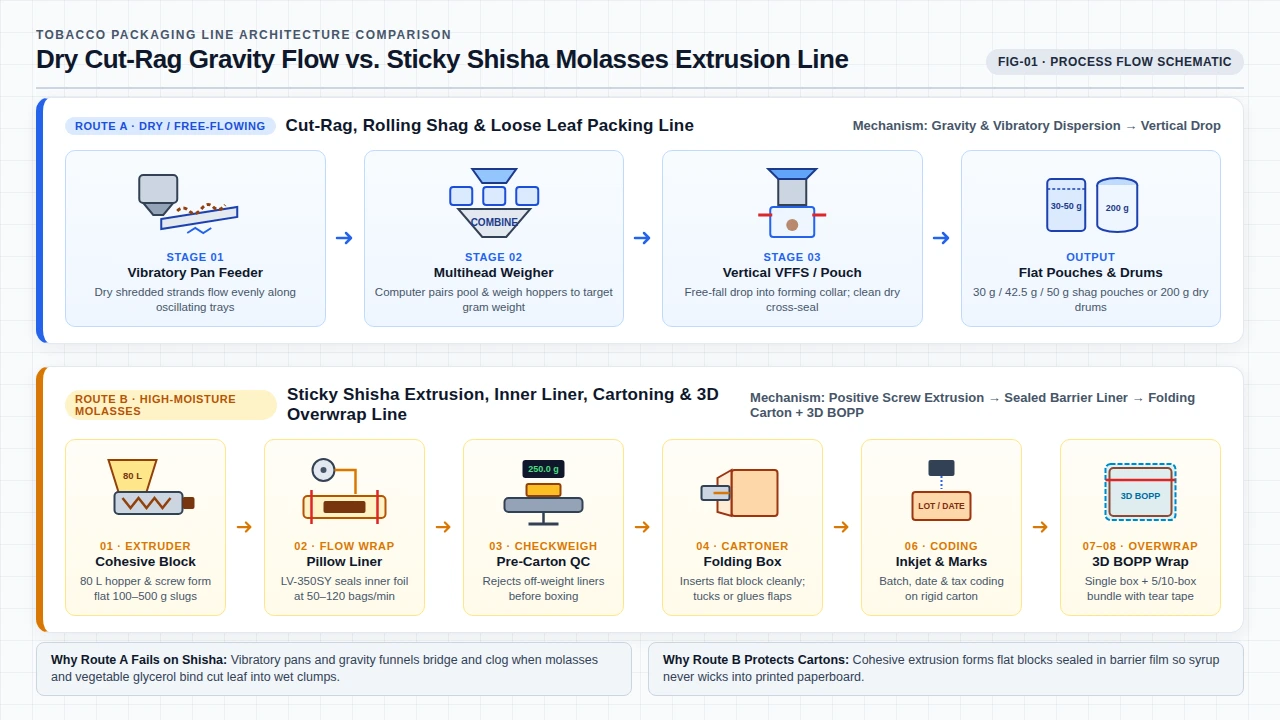
An automated tobacco packing line diverges into two distinct mechanical architectures driven by moisture and binder viscosity: dry cut-rag and rolling blends flow by gravity and vibration across multihead combination weighers into vertical baggers or pouches, whereas wet shisha molasses containing vegetable glycerol requires cohesive screw extrusion, sealed barrier inner pillow liners, folding cartons, and 3D BOPP overwrapping.
Attempting to run sticky hookah molasses through free-fall dry-leaf hoppers or unlined paperboard cartons causes immediate chute bridging, clogged sealing jaws, and glycerin bleed across printed box panels. Before sizing primary fillers or downstream cartoners, align your blend’s physical flow behavior with the equipment architectures across our shisha tobacco packaging line and machine selection guide.
How Do Retail Tobacco Packaging Formats Differ Across Boxes, Pouches, and Tins?
Retail tobacco packaging formats divide by moisture retention and crush protection across rigid paperboard boxes with foil inner liners and pull-tab overwrap, flat rolling pouches from 30 to 50 g or 200 g dry drums, airtight tins and canning jars for moist pipe cuts, and 20 to 2500 g barrier formats engineered specifically for sticky shisha molasses.
Cigarette Packs, Rolling Pouches, and Pipe Tins
As documented in Wikipedia’s cigarette pack overview, a conventional paperboard hard pack combines a flavor-protective foil, paper, or plastic inner liner with a transparent airtight plastic overwrap opened via pull-tabs; hard packs prevent crushing and reclose after opening, whereas thin-paper soft packs rupture more easily and cannot be resealed. At the wholesale level, a cigarette master carton usually bundles 10 packs totaling 200 sticks, with larger cartons holding 20 packs totaling 400 sticks.
Loose rolling and pipe tobaccos follow different moisture rules. Rolling (shag) tobacco is thinly cut loose tobacco commonly sold in flat tobacco pouches originally sized at 50 grams and now often 42.5 grams—with regulated markets reducing roll-your-own pouches to 30 grams—while drier, more finely cut cigarette-tube tobacco is packed into 200 gram packs or drums. By contrast, pipe tobacco is substantially more moist and cut much more coarsely into long narrow ribbons, pressed plugs sliced into flakes, or wound ropes sliced into discs, so it must be stored in an airtight canning jar or sealed tin to keep from drying out.
Commercial Shisha Molasses Format Windows
Commercial shisha blends span the widest weight window—from 20 to 100 g vertical roll-film sachets and 100 to 500 g boxed inner pillow blocks or stand-up zipper pouches up to 50 to 2500 g rigid tubs and lounge bulk containers, detailed in our shisha packaging formats guide.
| Tobacco Category | Cut & Moisture Profile | Primary Retail Format | Typical Pack Weight or Count | Primary Protection Mechanism |
|---|---|---|---|---|
| Factory cigarettes | Dry cut-rag rods | Paperboard hard pack or thin-paper soft pack | 10-pack (200) or 20-pack (400) master cartons | Flavor-protective foil/paper/plastic liner plus clear pull-tab overwrap |
| Rolling (shag) & tube cut | Thinly cut loose strands or drier fine cut | Flat flexible tobacco pouches or dry drums | 30 g, 42.5 g, or 50 g pouches; 200 g drums | Sealed flat pouch film or lidded drum retaining target blend humidity |
| Moist pipe tobacco | Coarse ribbons, sliced flakes, or rope discs | Airtight sealed tins or canning jars | Retail tin and jar portions | Rigid airtight closure preventing coarse cuts from drying out |
| Sticky shisha molasses | Wet cut leaf bound with molasses and vegetable glycerol | Sachet, pillow-in-carton with 3D wrap, zipper pouch, or PP tub | 20–100 g sachets; 100–500 g retail; 50–2500 g tubs/bulk | Sealed inner barrier laminate or aluminum induction foil under cap |
Why Does Wet Molasses Require a Barrier Tobacco Packing Liner Inside the Carton?
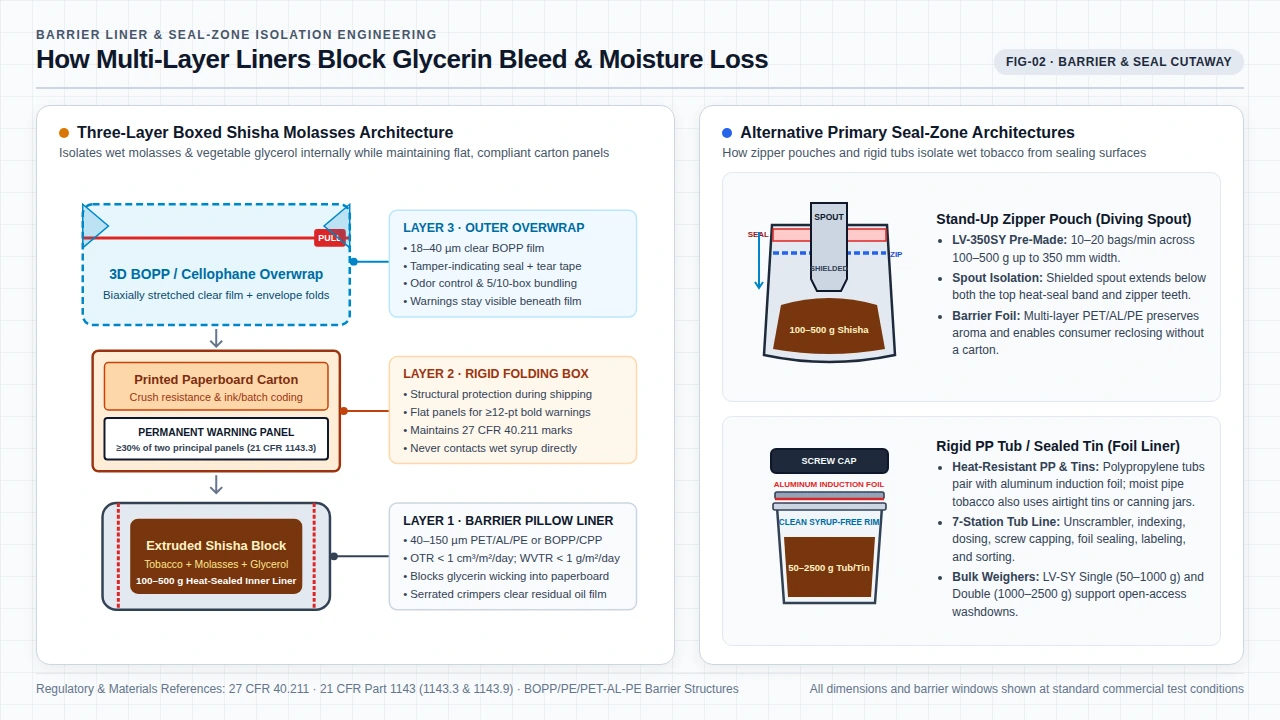
Wet shisha molasses requires a heat-sealed barrier inner liner inside the folding carton because mu’assel is a wet mixture of tobacco, molasses or honey, vegetable glycerol, and flavorings that would wick directly into unlined paperboard, ruining shelf presentation and violating statutory package containment and marking rules.
Even dry cigarette boxes rely on an internal flavor-protective foil, paper, or plastic liner beneath the outer clear film to preserve aroma. When liquid vegetable glycerol and sugar syrup are present in hookah molasses, a folded paper wrap is no longer sufficient: free syrup migrates through seams and stains printed cartons during warm warehousing or air freight.
Regulatory compliance reinforces this barrier requirement. Under 27 CFR 40.211, manufacturers must place all tobacco products before removal subject to tax into packages constructed to securely contain the products therein and maintain every required mark and notice. If glycerin seeps through a folding box, the carton loses structural integrity and risks obscuring mandatory tax or health markings.
On an automated shisha tobacco packaging line, the primary barrier liner is formed continuously around cohesive extruded blocks by the LV-350SY Horizontal Flow Wrapper at 50 to 120 bags/min across 100 to 500 g portions. Only after the inner pillow liner is hermetically heat-sealed and checkweighed does it slide cleanly into the printed folding carton and enter the 3D overwrapper.
When Does a Tobacco Packing Line Feed Pouches vs. Rigid Folding Boxes?
Choose a pouch-feeding line when retail reclosability, single-layer SKU simplicity, and compact 10 to 25 bags/min output fit your volume, and choose a horizontal pillow-to-folding-box line when you require 50 to 120 primary bags/min throughput, crush-proof stacking, multi-carton 3D bundling, and flat principal display panels for permanent warning compliance.
Premade Zipper Pouches and Vertical VFFS Sachets
A flexible pouch route eliminates secondary folding cartons altogether, making it practical for brands prioritizing consumer reclosability or entry-size trial packs. For 100 to 500 g stand-up and zipper pouches up to 350 mm wide, the LV-350SY Pre-Made Pouch Machine cycles at 10 to 20 bags/min on a 4799 × 779 × 1450 mm, 450 kg frame. Because wet syrup dripping across zipper teeth or heat-seal jaws destroys closure integrity, a shielded diving filling spout enters the pouch mouth below both the zipper track and top heat-seal band before discharging the metered portion.
For smaller 20 to 100 g convenience sachets measuring 80 to 240 mm long by 50 to 150 mm wide, the LV-320SY Vertical VFFS Machine operates at 10 to 25 bags/min on an 1185 × 935 × 1245 mm base frame (450 kg, 220V, 50Hz, 3.2 kVA).
Rigid Folding Cartons and Regulatory Display Panels
High-volume retail brands distributing 100 to 500 g shisha boxes step up to an automated cartoning line built around the LV-350SY Horizontal Flow Wrapper (50 to 120 bags/min, 80 L hopper, 1417.5 × 750 × 1290 mm, 200 kg, 220V, 50/60Hz, 2.4 kW). Rigid folding cartons deliver crush protection during distribution, stack uniformly on retail shelves, and collate cleanly into 5- or 10-carton master bundles at Station 08 of the 8-station Straight-Line layout.
Flat paperboard faces also simplify compliance in regulated markets. Under 21 CFR Part 1143, federal definitions cover any pack, box, carton, container, or clear wrapping offered to consumers (21 CFR 1143.1). For covered tobacco products distributed in the United States, 21 CFR 1143.3 mandates that the nicotine warning appear directly on the package, stay clearly visible underneath cellophane or other clear wrapping, occupy at least 30 percent of each of the two principal display panels, and print in at least 12-point bold sans-serif text. Crucially, 21 CFR 1143.9 prohibits placing warnings only on a removable clear outer wrapper—meaning the warning must be permanently printed on the carton or primary pouch itself—while 21 CFR 1143.11 exempts products not manufactured, packaged, or imported for U.S. distribution.
| Decision Criterion | Pre-Made Zipper Pouch (LV-350SY Pre-Made) | Vertical VFFS Sachet (LV-320SY) | Inner Pillow + Folding Carton + 3D Wrap (LV-350SY Horizontal) |
|---|---|---|---|
| Portion weight envelope | 100–500 g | 20–100 g | 100–500 g inner pillow block |
| Primary speed rating | 10–20 bags/min | 10–25 bags/min | 50–120 bags/min primary wrap |
| Maximum bag or film size | Up to 350 mm pouch width | Length 80–240 mm × Width 50–150 mm | Up to 350 mm roll-film width |
| Reclosability & crush resistance | Integrated zipper; flexible standing pouch | Single-use pillow sachet; flexible | Rigid paperboard box; optional 5- or 10-carton bundling |
| Seal-zone contamination control | Shielded diving spout below zipper and seal band | Vertical drop timing through forming collar | Cohesive horizontal block extrusion from 80 L hopper |
Which Tobacco Packing Material Layers Block Moisture Loss and Glycerin Migration?
Multi-layer barrier laminates from 40 to 150 micrometers—especially PET/AL/PE aluminum-foil structures achieving oxygen transmission below 1 cm³/m²/day and water vapor transmission below 1 g/m²/day—block moisture loss and glycerin migration inside primary packs, while 18 to 40 micrometer BOPP film provides crisp outer 3D overwrapping and heat-resistant polypropylene tubs pair with aluminum foil seals.
Primary Flexible Films vs. Multi-Layer Foil Laminates
Selecting packaging films strictly by cost per kilogram leads to aroma fade or weeping seals because single-layer polymers trade stiffness against barrier performance:
- Biaxially oriented polypropylene (BOPP): As noted in Wikipedia’s polypropylene reference, BOPP is extruded and stretched in both the machine direction and transverse direction. Flow-wrap BOPP runs 18 to 40 micrometers thick with heat-sealable initiation typically around 100 to 125 °C and uncoated water vapor transmission of 4 to 10 g/m²/day—making it ideal for stiff, crystal-clear outer 3D carton overwrap and dry flow wrap, though uncoated grades offer low oxygen barrier.
- Polyethylene (PE) films: Running 30 to 100 micrometers thick, PE provides strong moisture barrier performance at 0.5 to 2.5 g/m²/day water vapor transmission and forgiving heat seals, yet plain PE lacks sufficient aroma and oxygen barrier on its own for long-shelf-life flavored tobacco.
- Multi-layer laminated barrier films: Combining outer PET or BOPP stiffness, a middle aluminum foil or metallized barrier, and a PE or CPP inner sealant layer across 40 to 150 micrometers brings oxygen transmission below 1 cm³/m²/day and water vapor transmission below 1 g/m²/day. Specifically, PET/AL/PE delivers very high light, oxygen, and aroma protection for wet shisha pouches and inner liners, while BOPP/CPP balances stiffness and heat sealing.
Rigid Polypropylene Tubs and Outer 3D Overwrap
Polypropylene is harder and more heat-resistant than polyethylene, enabling rigid tubs to be sealed cleanly with aluminum foil on our 7-station rigid container filling line. Outside the carton, polypropylene or polyethylene overwrap closed with heat seals, PSA tape, or adhesive prevents pilferage or premature opening, provides tamper indication, controls odor leakage and cross-contamination, and combines cartons into multi-packs.
| Material Layer Structure | Typical Thickness | Moisture Barrier (WVTR) | Oxygen & Aroma Barrier | Primary Tobacco Line Role |
|---|---|---|---|---|
| Uncoated or heat-sealable BOPP | 18–40 micrometers | 4–10 g/m²/day (uncoated) | Low unless coated or metallized | Outer 3D carton overwrap with tear tape; dry flow wrap |
| Polyethylene (PE) mono-film | 30–100 micrometers | 0.5–2.5 g/m²/day | Low aroma and oxygen barrier | Inner heat-sealant web or moisture-resistant liner layer |
| Laminated barrier film (PET/AL/PE, BOPP/CPP) | 40–150 micrometers | Below 1 g/m²/day | Below 1 cm³/m²/day (PET/AL/PE) | Primary wet shisha inner pillow liner and stand-up zipper pouch |
| Polypropylene tub + aluminum foil | Rigid molded wall + foil liner | Hermetic rim weld | High foil vapor barrier | 50–1000 g rigid retail tubs and jars under screw cap |
How Does a Tobacco Packing Machine Adapt Dosing to Dry vs. High-Moisture Blends?
A tobacco packing machine adapts to blend moisture by switching from gravity and vibratory multihead combination weighing on dry cut-rag to positive belt or screw extrusion, shielded diving spouts, or open-access sticky-product weighers on wet shisha molasses—while adjusting compression density and humidity control to match leaf cut and stickiness.
Gravity and Vibratory Weighing for Dry Cut-Rag
Because tobacco varieties differ substantially in flavor, leaf cut, and moisture content, packing machinery must adjust packing density, feeding alignment, and in-process moisture control rather than forcing every blend through one feeder geometry.
On dry cut-rag, rolling shag, and free-flowing loose leaf, multihead weighers deliver high speed and precision: product disperses by gravity, vibration, or centrifugal force into pool hoppers and weigh hoppers, where the weigher computer selects the hopper combination closest to the target weight (such as 100 g) and drops it down a discharge chute into a vertical form-fill-seal bagmaker. Just as loose tea and dry granules run accurately on multihead weighers, dry cut tobacco drops cleanly without clinging to angled pans.
Positive Extrusion, Diving Spouts, and Sticky Weighers for Wet Molasses
Once molasses, honey, and vegetable glycerol coat the cut leaf, gravity and vibration fail completely. As documented in multihead weighing practice for sauced or wet food products, sticky materials must be conveyed by belts or screw feeders rather than vibration. Shisha lines implement this principle across three purpose-built dosing routes:
- Cohesive horizontal screw extrusion (high-speed cartons): An 80 L hopper and upstream extruder meter 100 to 500 g sticky tobacco into compact, flat-profile blocks feeding the LV-350SY Horizontal Flow Wrapper at 50 to 120 bags/min, preventing loose fibers from entering cross-seal crimpers or jamming the downstream cartoner.
- Shielded diving spout dosing (pre-made zipper pouches): The LV-350SY Pre-Made Pouch Machine lowers a shielded spout past the zipper track and top seal band so 100 to 500 g wet portions drop cleanly into the pouch base at 10 to 20 bags/min.
- Open-access sticky-product weighing (multi-flavor tubs and bulk): For frequent flavor swaps across rigid jars or lounge pails, the LV-SY Single Weighing Machine (50 to 1000 g, 1307 × 872 × 1614 mm, 250 kg, 1.5 kW) and LV-SY Double Weighing Machine (1000 to 2500 g, 2328 × 844 × 1614 mm, 500 kg) pair anti-sticking contact surfaces with open washdown access.
| Tobacco Blend Class | Dominant Flow Behavior | Recommended Dosing Mechanism | Failure Mode With Wrong Feeder | Washdown & Changeover Impact |
|---|---|---|---|---|
| Dry cut-rag & rolling shag | Free-flowing shredded strands | Vibratory feeder + multihead combination weigher | Excessive fines if over-compressed | Dry brush and vacuum clearing between blends |
| Moist coarse pipe tobacco | Springy ribbons, flakes, or plugs | Adjustable-density feeder + humidity control into tins or pouches | Torn flakes or dried leaf under open airflow | Moderate dry/wipe changeover between aromatic blends |
| Wet shisha molasses (100–500 g retail) | Cohesive, syrup-bound sticky mass | 80 L hopper + screw extruder (horizontal) or diving spout (pouch) | Chute bridging, hopper clinging, and contaminated heat seals | 20–45 min upstream hopper/extruder washdown between flavor families |
| Wet shisha molasses (50–2500 g multi-SKU) | Heavy wet batches across rotating flavors | LV-SY Single (50–1000 g) or Double (1000–2500 g) sticky weigher | Slow teardowns on enclosed high-speed lines | Rapid open-access stainless washdown between flavors |
What Drives Tobacco Packing Machine Cost and Line Scope From Dosing to Overwrapping?
Tobacco packing machine investment and scope are driven by five engineering variables—automation tier, primary pack architecture, sticky-molasses dosing mechanism, number of SKU change-part sets, and downstream checkweighing, cartoning, coding, and 3D overwrapping stations—with real shift output governed by the bottleneck station at 70 to 80% OEE rather than standalone wrapper speed.
Five Engineering Scope Drivers and Staged Automation
Comparing machine proposals requires separating five technical cost centers rather than judging a line by frame length alone, as detailed in our shisha packing machine price guide:
- Automation tier: Semi-automatic sticky weighers (LV-SY Single at 250 kg or LV-SY Double at 500 kg) minimize entry complexity, whereas fully automatic multi-station lines replace manual pouch loading and hand cartoning.
- Primary pack architecture: Roll-film horizontal flow wrapping (LV-350SY Horizontal, 200 kg) and vertical VFFS (LV-320SY, 450 kg) use continuous roll stock, while pre-made pouch systems (LV-350SY Pre-Made, 4799 × 779 × 1450 mm, 450 kg) add magazine pick-and-place, zipper opening, and diving-spout mechanisms.
- Sticky-molasses dosing head: Replacing dry vibratory scales with dedicated screw extruders or anti-sticking contact weighers accounts for a substantial share of mechanical precision.
- SKU change-part sets: Running multiple sachet widths within the 50 to 150 mm LV-320SY window, multiple carton dimensions, or different rigid container diameters requires extra forming collars, carton molds, or starwheels.
- Downstream quality and secondary stations: Adding inline checkweighing, inkjet coding, automatic cartoning, and single- or master-bundle 3D cellophane overwrapping expands both footprint and line synchronization requirements.
Straight-Line (8-Station) vs. Corner-Type (5-Station) Layout and Bottleneck Balance
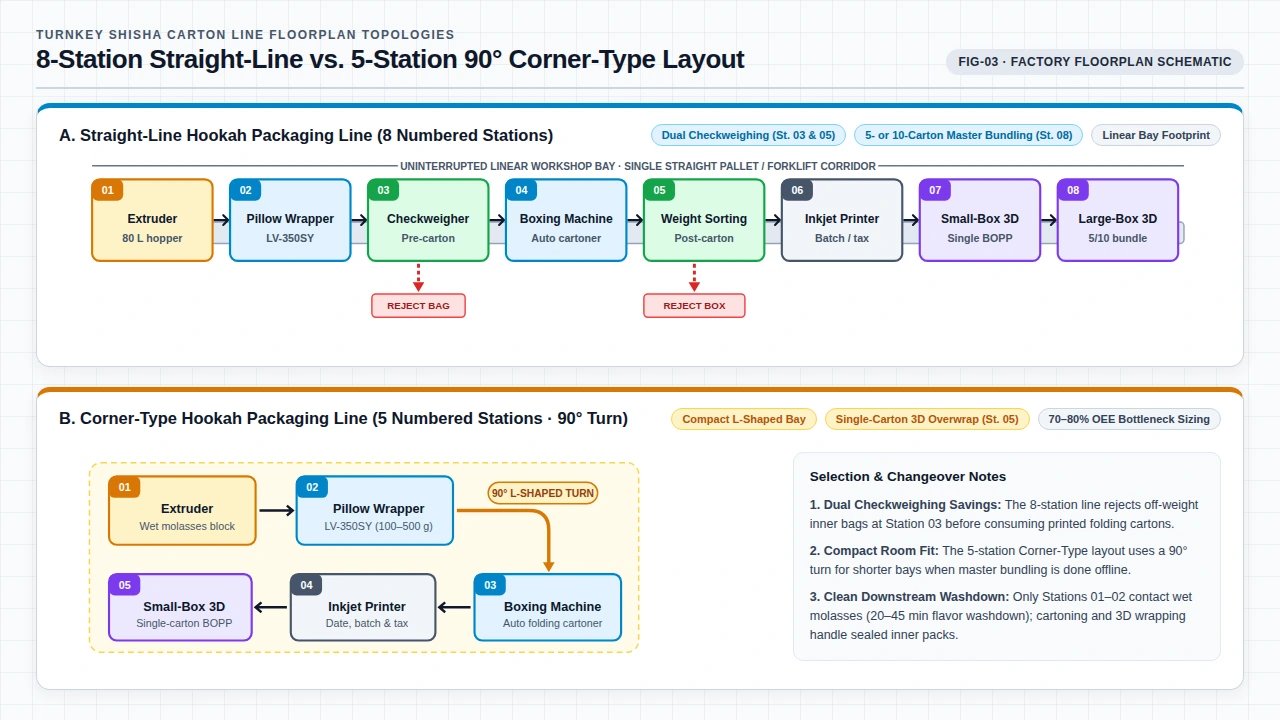
For turnkey boxed shisha production, factories choose between two standard integrated layouts: the linear 8-station Straight-Line Hookah Packaging Line and the compact 90-degree 5-station Corner-Type Hookah Packaging Line. On the 8-station Straight-Line, Station 03 Checkweigher inspects every inner pillow pack immediately after the LV-350SY wrapper so underweight or overweight bags are rejected before consuming a printed folding carton or BOPP film, followed by Station 05 Weight Sorting after boxing and Station 08 master-bundle 3D overwrapping for 5 or 10 cartons per bundle.
When modeling shift output in our shisha packaging line capacity guide, calculate net production from the bottleneck station—typically upstream molasses extrusion or downstream 3D cellophane overwrapping—at a realistic 70 to 80% Overall Equipment Effectiveness (OEE). Because only the upstream extruder and primary forming path touch raw wet tobacco, flavor changeovers require 20 to 45 minutes of upstream washdown (covered in our cleaning and flavor changeover guide) while downstream checkweighers, cartoners, inkjet coders, and 3D overwrappers handle only sealed packs. Always verify connected-line synchronization during sample testing and Factory Acceptance Testing (FAT) before shipment.
| Line Planning Variable | Straight-Line Hookah Packaging Line (8 Stations) | Corner-Type Hookah Packaging Line (5 Stations) | Factory Engineering Impact |
|---|---|---|---|
| Floor geometry | Linear inline arrangement from extruder to bundle exit | Compact 90-degree L-shaped turn layout | Fits shorter workshop bays when linear length is constrained |
| Inline weight verification | Station 03 pre-carton checkweigher + Station 05 post-carton weight sorting | Direct 90-degree transfer from pillow wrapper to boxing | Pre-carton rejection prevents wasting printed cartons and BOPP film |
| Coding & traceability | Station 06 inkjet printer on filled carton | Station 04 inkjet printer on filled carton | Supports date, lot, and tax marking on rigid box panels |
| 3D BOPP overwrapping | Station 07 single-box 3D wrap + Station 08 5- or 10-carton master bundle | Station 05 single-box 3D wrap (master bundling separate) | Choose 8-station line for automated 5- or 10-pack wholesale bundles |
| Shift sizing & washdown | Bottleneck-governed at 70–80% OEE; 20–45 min upstream flavor washdown | Bottleneck-governed at 70–80% OEE; 20–45 min upstream flavor washdown | Downstream cartoning and overwrapping contact only sealed inner liners |
Frequently Asked Questions
Can a dry cut-rag multihead weigher line pack wet shisha molasses?
No. Dry cut-rag and rolling tobacco rely on gravity and vibratory dispersion across multihead pool and weigh hoppers, whereas wet shisha molasses containing vegetable glycerol and syrup clings to vibratory pans and bridges discharge chutes. Sticky molasses blends require positive screw extrusion (such as an 80 L hopper feeding the LV-350SY Horizontal Flow Wrapper), shielded diving spouts on pre-made pouch machines, or open-access LV-SY sticky-product weighers.
Why does a boxed shisha packing line need an inner barrier pillow liner before cartoning?
Shisha mu’assel contains molasses or honey, vegetable glycerol, and flavorings that soak directly into unlined paperboard, staining the printed box and compromising aroma. A heat-sealed inner barrier pillow liner (such as 40 to 150 micrometer PET/AL/PE or BOPP/CPP) isolates syrup completely before boxing so the carton satisfies 27 CFR 40.211 secure containment and keeps required markings legible.
Which film layers best protect wet molasses tobacco inside a carton or pouch?
Multi-layer laminated films from 40 to 150 micrometers—especially PET/AL/PE aluminum-foil laminates achieving oxygen transmission below 1 cm³/m²/day and water vapor transmission below 1 g/m²/day—provide the strongest primary barrier against moisture loss and aroma migration. Outside the folding carton, 18 to 40 micrometer biaxially oriented polypropylene (BOPP) provides crystal-clear 3D overwrapping with tamper-indicating tear tape and odor control.
Where must mandatory health warnings appear when cartons are wrapped in 3D BOPP film?
For covered tobacco products manufactured, packaged, or imported for U.S. distribution under 21 CFR 1143.3 and 21 CFR 1143.9, required warnings must be indelibly printed or permanently affixed directly on the package, remain clearly visible underneath clear cellophane or BOPP wrapping across at least 30 percent of each of the two principal display panels in at least 12-point bold sans-serif text, and must never be placed only on a removable clear outer wrapper.
When should a factory pick the 8-station Straight-Line over the 5-station Corner-Type layout?
Pick the 8-station Straight-Line layout when you have linear bay length and want Station 03 pre-carton checkweighing (rejecting off-weight inner bags before wasting printed cartons), Station 05 post-carton weight sorting, and Station 08 automated 5- or 10-carton master-bundle 3D overwrapping. Pick the 5-station 90-degree Corner-Type layout when floor length is shorter and single-carton 3D overwrapping meets your downstream shipping workflow.
Sources
- eCFR — 27 CFR 40.211 (Tobacco Product Package Construction and Marking Requirements)
- eCFR — 21 CFR Part 1143 (Minimum Required Warning Statements for Tobacco Products)
- Wikipedia — Mu'assel (Hookah Molasses, Vegetable Glycerol, and Flavoring Composition)
- Wikipedia — Cigarette Pack (Hard Pack vs. Soft Pack, Inner Liners, Pull-Tab Overwrap, and Master Cartons)
- Wikipedia — Pipe Tobacco (Coarse Moisture Cuts, Ribbons, Flakes, and Airtight Storage Containers)
- Wikipedia — Rolling Tobacco (Cut-Rag Shag Pouch Weights and 200 g Dry Cigarette-Tube Drums)
- Wikipedia — Multihead Weigher (Gravity and Vibratory Combination Weighing vs. Belt and Screw Feeders for Sticky Products)
- Wikipedia — Overwrap (Polypropylene and Polyethylene Film Overwrapping, Tamper Indication, Odor Control, and Multi-Packs)
- Wikipedia — Polypropylene (Biaxially Oriented Polypropylene BOPP Film and Heat-Resistant Polypropylene Tubs)
Configure Your Shisha Packaging Line with LINEVO Engineers
Send your shisha tobacco pack format, target gram weight, and required speed on WhatsApp to receive technical drawings, trial videos, and an itemized factory quotation, or check our RFQ preparation checklist.
Get Quote via WhatsAppBrowse all Shisha Packaging Guides