BOPP film (biaxially oriented polypropylene) is extruded polypropylene stretched across both the machine and transverse directions to create a stiff, high-clarity, low-density packaging web. Running 18 to 40 μm thick at 0.90 to 0.91 g/cm³ density, heat-sealable BOPP excels in 3D carton overwrapping and dry flow wrapping, whereas wet molasses tobacco requires multi-layer barrier laminates.
Choosing the wrong BOPP specification—such as running plain non-sealable film on a high-speed overwrapper or expecting uncoated BOPP to lock in wet shisha aroma—causes wrinkled envelope folds, weak end seals, and rapid flavor loss. Before finalizing roll-stock dielines for your shisha flow packing machine or automated shisha tobacco packaging line, match the polymer structure to each station’s sealing, friction, and barrier requirements.
What Is BOPP Film Made Of and How Is It Oriented?
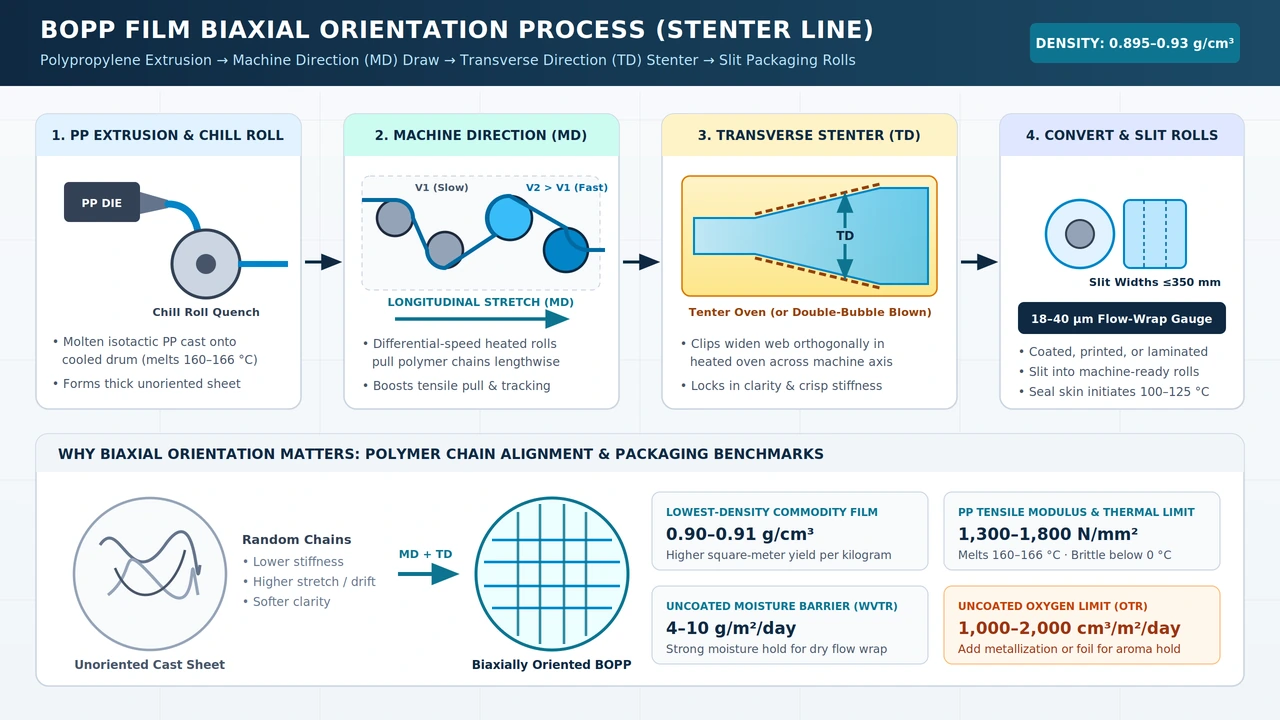
BOPP film is made from polypropylene resin that is extruded into a sheet and stretched in both the machine direction and across the machine direction using either a bi-directional stenter process or a double-bubble blown film extrusion process, aligning polymer chains to increase tensile strength and optical clarity.
Stenter vs. Double-Bubble Orientation and Converting
Manufacturers produce biaxially oriented polypropylene through two primary industrial methods: a bi-directional stenter (tenter) line or a double-bubble blown film extrusion line. Stretching the polypropylene film longitudinally along the machine direction and orthogonally across the transverse direction transforms a soft extruded sheet into a crisp, transparent, flexible web that tracks reliably through automated rollers.
Because polypropylene is chemically non-reactive, BOPP is safe for direct food and pharmaceutical packaging as well as labels and stickers. Converters manufacture BOPP in wide master rolls, then coat, print, or laminate the web to achieve target barrier or aesthetic finishes before slitting master rolls on slitting machines into narrow rolls sized for individual packaging machines.
Density, Stiffness, and Thermal Operating Limits
Polypropylene has a density between 0.895 and 0.93 g/cm³, making it the lowest-density commodity plastic; typical flow-wrap BOPP grades sit around 0.90 to 0.91 g/cm³. Lower density translates directly into higher square-meter yield per kilogram of roll stock compared with heavier polymers.
Mechanically and thermally, polypropylene combines a Young’s modulus between 1,300 and 1,800 N/mm² with a commercial isotactic melting point of 160 to 166 °C, while perfectly isotactic polypropylene melts at 171 °C. Operators handling cold-chain or winter air-freight distribution must note one critical boundary: below 0 °C, polypropylene becomes brittle, increasing impact crack risk compared with tougher polyethylene webs.
| BOPP Core Property | Typical Material Range | Practical Packaging Implication |
|---|---|---|
| Base polymer & orientation | Polypropylene stretched in MD and TD (stenter or double-bubble) | High optical clarity, stiff web tracking, and crisp folding behavior |
| Resin & flow-wrap density | 0.895–0.93 g/cm³ (PP resin); 0.90–0.91 g/cm³ (flow-wrap BOPP) | Lowest commodity plastic density; more film area per kilogram |
| Flow-wrap gauge range | 18–40 μm typical thickness | Thin enough for clean carton corners while stiff enough for high speed |
| Polypropylene stiffness | 1,300–1,800 N/mm² Young’s modulus | Resists stretching and print drift across forming shoulders |
| Thermal window | Melts 160–166 °C (commercial isotactic); brittle below 0 °C | Heat-sealable grades seal at 100–125 °C without melting the core |
| Uncoated barrier profile | 4–10 g/(m²·day) WVTR; 1,000–2,000 cm³/(m²·day) OTR (23 °C, 50% RH) | Solid moisture barrier for dry goods; needs barrier layers for oxygen/aroma |
How Many Types of BOPP Film Are Used in Packaging?
Commercial converters supply BOPP across six practical packaging families—clear glossy transparent film, matte and silky satin surface finishes, heat-sealable co-extruded overwrap grades, vacuum-metallized BOPP, 15 to 60 μm carton lamination and high-barrier composite webs, and wrap-around label films—each engineered for a specific converting or sealing task.
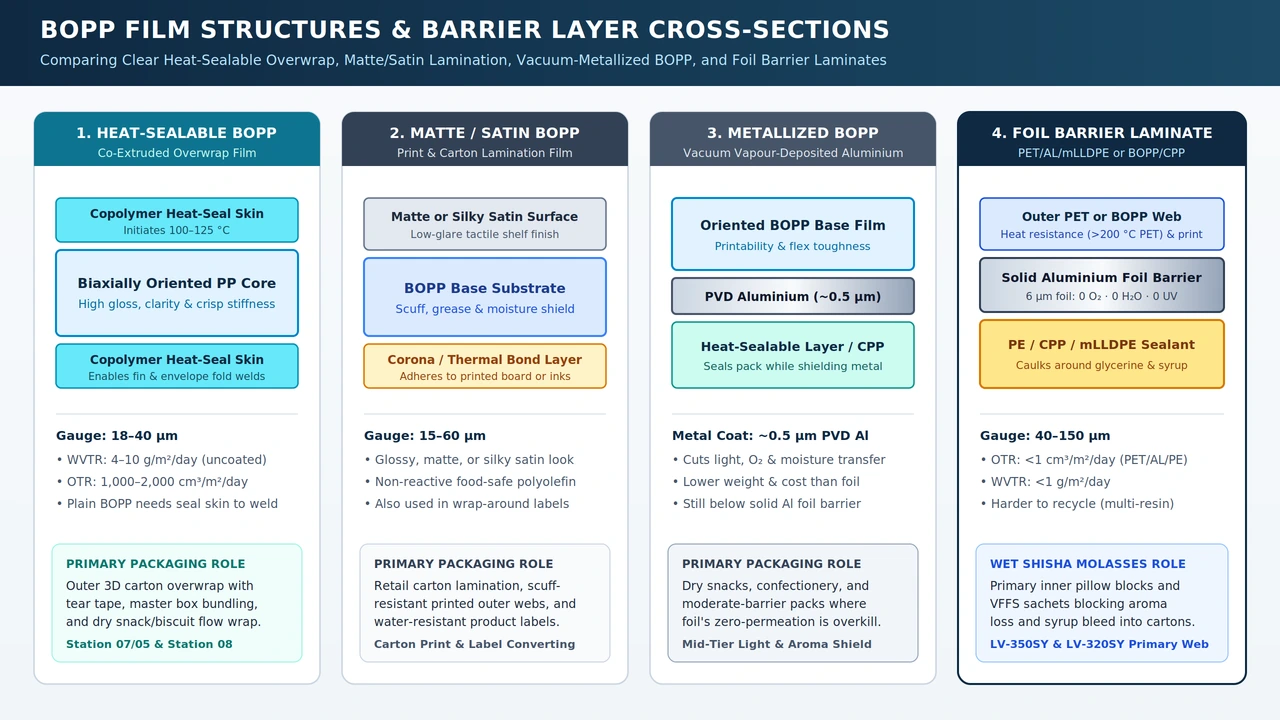
Selecting the right BOPP grade starts with separating plain non-sealable base films from co-extruded or coated packaging webs. Standard plain BOPP is not naturally an easy-seal material because the oriented homopolymer core shrinks or distorts near its 160 to 166 °C melting range. Consequently, commercial flow-wrapping and overwrapping lines specify heat-sealable BOPP engineered with lower-melting copolymer skins or coatings that initiate seals around 100 to 125 °C while the oriented core remains dimensionally stable.
For outer branding and secondary paperboard converting, film suppliers provide glossy BOPP for high-shine retail clarity, matte BOPP for low-glare cartons, silky satin finishes for soft sheen, wrap-around label grades including holographic options, and 15 to 60 μm lamination films. When a single polyolefin web cannot satisfy both seal strength and shelf life, converters laminate BOPP to cast polypropylene (BOPP/CPP) or move to 40 to 150 μm multi-layer foil barrier laminates.
| BOPP Film Type | Typical Gauge or Layer Structure | Key Functional Advantage | Best Packaging Application |
|---|---|---|---|
| Clear glossy heat-sealable BOPP | 18 to 40 μm core with 100 to 125 °C copolymer seal skin | High transparency, gloss, crisp folds, and reliable fin or envelope seals | 3D tobacco/shisha carton overwrap and dry biscuit or snack flow wrap |
| Matte and silky satin BOPP | 15–60 μm lamination and print grades | Low-glare or soft-glow tactile finish with scuff and moisture protection | Printed folding cartons, retail sleeves, and premium outer print webs |
| Plain non-sealable BOPP | Co-converted base roll for coating or laminating | High tensile clarity and low density as an outer structural print ply | Lamination substrate paired with CPP, PE, or foil sealant webs |
| Metallized BOPP | Oriented PP with 20–50 nm (0.02–0.05 μm) vacuum-deposited aluminium | Blocks light, moisture, and oxygen at lower weight and cost than foil | Dry snacks, confectionery, and moderate-barrier flexible packs |
| BOPP/CPP composite laminate | 40–150 μm laminated web range (outer BOPP + inner CPP) | Combines crisp outer print gloss with stronger, contamination-tolerant seals | High-speed horizontal flow-wrap packs and dry or semi-moist inner bags |
| Wrap-around label BOPP | Slit non-reactive polyolefin label stock (including holographic) | Water and chemical resistance with tight print registration | Bottles, jars, rigid tubs, and decorative product labeling |
What Is Metallized BOPP Film and When Do You Need Foil Instead?
Metallized BOPP film is oriented polypropylene vacuum-coated via physical vapor deposition with an ultra-thin aluminium layer typically 20 to 50 nm (0.02 to 0.05 μm, roughly 200 to 500 Å) thick, sharply lowering light, moisture, and oxygen permeability at lower weight and cost than solid foil—yet still falling short of 6 μm aluminium foil laminates when wet aroma-heavy products require near-zero permeation.
How Vacuum Metallization Changes BOPP Barrier Performance
During vacuum metallization (physical vapor deposition), aluminium is heated and evaporated inside a high-vacuum chamber so metal vapor condenses onto cold unwound polymer film—most commonly oriented polypropylene (PP) or PET—forming a non-fading reflective coating typically 20 to 50 nm (0.02 to 0.05 μm) thick. Unlike solid aluminium foil, metallized polymer retains the base film’s toughness, heat-sealability, and low density at lower material cost than solid foil laminates.
Both metallized PP and metallized PET have widely replaced foil laminates for snack foods and candy that benefit from controlled permeation and metallic shelf sparkle without requiring absolute foil impermeability. However, packaging engineers must separate moderate-barrier dry snacks from long-shelf-life wet tobacco: metallized films still cannot match the barrier ceiling of solid aluminium foil laminates.
Metallized Film vs. Solid Aluminium Foil Benchmarks
Reference comparisons on PET and BOPP substrates illustrate the order-of-magnitude step from plain plastic to vacuum metallization to solid aluminium foil, alongside industrial horizontal laminate targets:
| Barrier Structure | Thickness / Metal Layer | Moisture Transmission (WVTR) | Oxygen Transmission (OTR) | UV Light Transmittance | Engineering Role |
|---|---|---|---|---|---|
| Uncoated BOPP film | 18–40 μm mono-web | 4–10 g/(m²·day) | 1,000–2,000 cm³/(m²·day) (23 °C, 50% RH) | High transparent clarity | Outer 3D carton wrap and dry flow wrap |
| Plain PET film (reference) | 12.7 μm uncoated | 31 g/(m²·day) | 465 cm³/(m²·day) | 91% | Outer thermal-resistant print ply |
| Metallized PET (reference) | 20–50 nm (0.02–0.05 μm) PVD aluminium | ~0.8 g/(m²·day) | ~1.2 cm³/(m²·day) | ~5% | Moderate-barrier snacks and candy |
| Solid aluminium foil | 6 μm foil barrier | 0 g/(m²·day) | 0 cm³/(m²·day) | 0% | Core barrier ply inside high-barrier laminates |
| Multi-layer foil laminate (PET/AL/PE) | 40–150 μm total web | < 1 g/(m²·day) | < 1 cm³/(m²·day) | Near-total light block | Primary wet shisha molasses inner liners and pouches |
Because wet hookah molasses combines cut leaf, heavy fruit or mint flavorings, and liquid vegetable glycerine, relying on uncoated or lightly metallized mono-BOPP as the primary inner pack allows volatile aroma migration and seam weeping. Reserve metallized BOPP for dry or moderate-barrier products, and specify solid foil laminates such as PET/AL/PE or PET/AL/mLLDPE for primary wet shisha pouches and boxed inner pillow blocks.
What Is BOPP Film Used For in Tobacco Carton Overwrapping and Shisha Flow Wrapping?
In tobacco and shisha packaging, heat-sealable BOPP (18 to 40 μm) serves primarily as the transparent outer 3D carton overwrap with envelope-folded corners and pull-tab tear tape, whereas primary roll-film inner pillow packs on high-speed horizontal flow wrappers and vertical VFFS machines pair outer BOPP or PET webs with contamination-tolerant CPP, PE, or foil barrier laminates.
3D Carton Overwrapping, Tear Tape, and Master Bundling
Plastic overwraps made of polypropylene or polyethylene seal around paperboard cartons via heat seals, PSA tape, or adhesive to bundle multi-packs, prevent pilferage or premature opening, provide a tamper-indicating seal, resist grease and water, and control odor leakage and cross-contamination. Standard paperboard cigarette packs combine an internal flavor-protective foil, paper, or plastic liner with a transparent airtight plastic outer wrap opened via pull-tabs.
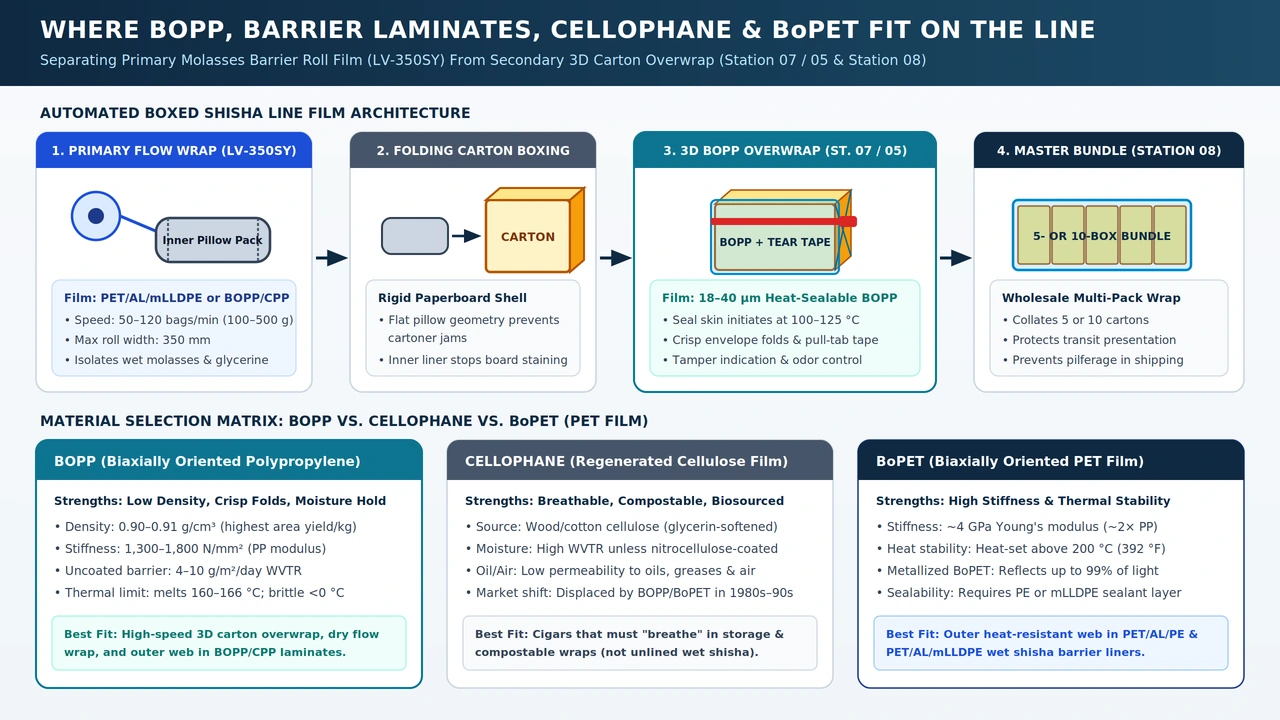
Automated shisha cartoning lines mirror this two-tier defense. On our shisha tobacco packaging line, Station 07 on the Straight-Line layout—or Station 05 on the Corner-Type layout—wraps each printed folding carton in clear BOPP film with precision envelope-folded corners and an integrated tear-off tape strip. For wholesale distribution, Station 08 on the Straight-Line collates multiple wrapped retail boxes—such as 5 or 10 cartons per bundle—and applies a tight outer 3D film wrap ready for master case packing.
Roll-Film Inner Liners on Flow Wrappers and VFFS Machines
Inside the folding carton, primary film choice shifts from optical gloss to seal integrity under molasses contamination. On the LV-350SY Horizontal Flow Wrapper, continuous roll stock up to 350 mm wide forms tight, flat inner pillow packs around cohesive extruded shisha blocks at 50 to 120 bags/min so packs slide cleanly into downstream cartoners without jamming. For smaller convenience portions, the LV-320SY Vertical VFFS Machine forms and fills 20 to 100 g sachets measuring 80 to 240 mm long by 50 to 150 mm wide at 10 to 25 bags/min.
Running an incompatible mono-BOPP web on these wrappers triggers three immediate failure modes:
- Weak or unsealed end crimps: Because standard BOPP is not naturally easy to heat seal, too thin a copolymer skin, powder or syrup contamination, or operating outside its 100 to 125 °C initiation window causes rapid seal-strength drop. In a documented horizontal flow-wrapper production trial, replacing glossy mono-BOPP with a BOPP/CPP structure using a contamination-tolerant sealant—and recalibrating jaw temperature downward with slightly longer dwell time—reduced film-related rejects from 4.6% to 1.8%.
- Web drift and print registration errors: A film with an excessively high coefficient of friction increases web tension across forming collars and folders, causing side drift and misaligned eye-mark cuts; a narrow seal initiation range forces operators to slow line speed or overheat jaws.
- Glycerine bleed in wet shisha seals: Where standard homopolymer PE or thin CPP struggles with trace glycerine mist, specifying PET/AL/mLLDPE (metallocene linear low-density polyethylene) delivers stronger hot-tack and caulks around trace syrup or oil droplets.
For machine-level comparisons between roll stock and pre-formed bags, review Premade Pouch vs. Roll-Film Shisha Packaging, troubleshoot leaking seams in Shisha Pouch Sealing Problems & Solutions, and compare wet molasses lines against dry cut-rag lines in our Tobacco Packing Line Guide.
BOPP vs. Cellophane and BoPET Film: Which Packaging Film Fits Your Line?
Choose heat-sealable BOPP for economical, moisture-resistant 3D carton overwrapping and dry flow wrapping; choose regenerated cellulose cellophane only when compostability or water-vapor breathability (as in cigar storage) is required; and choose BoPET (biaxially oriented PET) as the stiff, heat-resistant outer ply in multi-layer foil laminates for wet shisha tobacco.
BOPP vs. Cellophane on Overwrapping Machines
Many packaging buyers still say “cellophane wrapper” when ordering BOPP rolls. In the United States and several other countries, “cellophane” became genericized to describe petrochemical plastic wraps, prompting material scientists to use “cellulose film” to distinguish true regenerated cellulose from BOPP.
Chemically, true cellophane is a thin transparent sheet made from wood, cotton, or hemp cellulose rather than polypropylene. Uncoated cellophane offers low permeability to air, oils, greases, bacteria, and liquid water, but it is highly permeable to water vapor unless coated with nitrocellulose lacquer. That water-vapor breathability makes cellophane the most popular wrap for cigars that must breathe in storage, and cellophane is biosourced, compostable, and biodegradable. However, cellophane lost mainstream carton overwrapping share to lower-cost petrochemical BOPP and BoPET during the 1980s and 1990s, driven both by economics and by carbon disulfide pollution associated with traditional viscose production. On high-speed shisha box overwrappers where moisture retention and low unit film cost lead, heat-sealable BOPP is the standard choice.
BOPP vs. BoPET (PET) and Polyethylene (PE) Film
Comparing BOPP against BoPET (biaxially oriented polyethylene terephthalate) clarifies why foil laminates rarely put BOPP on the outside when sealing wet shisha pouches at high jaw temperatures. After sequential machine-direction and transverse-direction drawing, BoPET is heat-set and crystallized under tension above 200 °C (392 °F), yielding a typical Young’s modulus around 4 GPa—more than double polypropylene’s 1,300 to 1,800 N/mm² stiffness—alongside much higher thermal resistance. When vacuum-aluminized, BoPET reflects up to 99% of light (including much of the infrared spectrum) and laminates cleanly with polyethylene for heat sealability and puncture resistance.
Plain polyethylene (PE) sits at the opposite mechanical extreme: running 30 to 100 μm thick at 0.915 to 0.940 g/cm³ density, PE offers strong moisture barrier (0.5 to 2.5 g/(m²·day) WVTR) and forgiving 90 to 115 °C heat seals, but its higher oxygen transmission (1,500 to 3,500 cm³/(m²·day)) and softer, stretchier web handling make it less crisp than BOPP for high-speed overwrapping.
| Comparison Factor | Heat-Sealable BOPP | Regenerated Cellophane | BoPET (PET Film) | Plain PE (LDPE / LLDPE) | Multi-Layer Foil Laminate (PET/AL/PE) |
|---|---|---|---|---|---|
| Base material | Oriented polypropylene | Regenerated cellulose | Oriented polyester (PET) | Polyethylene | Outer PET + Al foil + PE or mLLDPE |
| Typical thickness | 18–40 μm (flow wrap) | Thin specialty sheet | 12.7 μm+ laminate ply | 30–100 μm | 40–150 μm total structure |
| Density | 0.90–0.91 g/cm³ | Higher than polyolefins | Higher than polyolefins | 0.915–0.940 g/cm³ | Multi-layer composite weight |
| Stiffness (Young’s modulus) | 1,300–1,800 N/mm² (PP) | Crisp dead-fold feel | ~4 GPa | Low to medium (elastic) | Medium to high (structure-dependent) |
| Thermal limit / seal initiation | Seals 100–125 °C; melts 160–166 °C | Non-melting cellulose base | Heat-set above 200 °C (392 °F) | Seals 90–115 °C | Controlled by inner PE/mLLDPE sealant |
| Moisture barrier (WVTR) | 4–10 g/(m²·day) (uncoated) | High permeation unless lacquered | 31 g/(m²·day) (12.7 μm plain) | 0.5–2.5 g/(m²·day) | < 1 g/(m²·day) |
| Oxygen barrier (OTR) | 1,000–2,000 cm³/(m²·day) (uncoated) | Low air permeability | 465 cm³/(m²·day) (12.7 μm plain) | 1,500–3,500 cm³/(m²·day) | < 1 cm³/(m²·day) |
| Primary tobacco & shisha role | 3D carton overwrap & master bundles | Breathable cigar wraps | Outer heat-resistant laminate web | Inner sealant ply or frozen/tough packs | Primary wet shisha pillow liners & pouches |
Is BOPP Film Recyclable in Commercial Packaging Streams?
Mono-material BOPP film is made from polypropylene—Resin Identification Code 5—which is technically recyclable through mechanical reprocessing or pyrolysis, but real-world recovery remains very low (under 1% of generated PP recycled as of 2015), and multi-layer BOPP laminates bonded to aluminium foil or dissimilar polymers are significantly harder to recycle.
Packaging buyers planning sustainability claims should distinguish resin chemistry from municipal collection reality:
- Resin Identification Code 5 is not a recyclability guarantee: ASTM International assumed administration of the coding system in 2008 under ASTM D7611 and revised the graphic mark in 2013 from “chasing arrows” to a solid triangle specifically to clarify that resin codes sort polymer type rather than confirming local recyclability.
- Thermal degradation limits mechanical PP recycling: In mechanical recycling, polypropylene is heated to soften or melt and reformed into new items. However, heating degrades polypropylene’s carbon backbone more severely than polyethylene because PP’s methyl side group is susceptible to thermo-oxidative and photo-oxidative degradation. As of 2015, less than 1% of polypropylene generated was recycled, with chemical pyrolysis studied as an alternative recovery pathway.
- Film recovery lags rigid bottle recycling: According to U.S. EPA plastics material-specific data, the overall U.S. plastic recycling rate in 2018 was 8.7% (3 million tons recycled), heavily concentrated in rigid containers such as PET bottles and jars (29.1%) and HDPE natural bottles (29.3%) rather than thin flexible films.
- Laminate complexity compounds end-of-life limits: Combining BOPP with aluminium foil, PET, or dissimilar heat-seal resins delivers superior aroma protection for wet shisha tobacco, but multi-material laminates cost more to manufacture and are more difficult to recycle than single-polymer webs.
Always validate both sealability and roll machinability—using your actual inner laminate, folding carton, and outer BOPP overwrap roll—during sample testing and Factory Acceptance Testing (FAT) before approving bulk film orders.
Frequently Asked Questions
What does BOPP stand for in packaging film?
BOPP stands for biaxially oriented polypropylene. It is produced by extruding polypropylene into a sheet and stretching it in both the machine direction and across the machine direction via a bi-directional stenter line or a double-bubble blown film process to increase clarity, stiffness, and tensile strength.
Can plain uncoated BOPP film be heat sealed on a flow wrapper or 3D overwrapper?
Standard plain BOPP is not naturally easy to heat seal because the oriented polypropylene core softens and melts around 160 to 166 °C. Commercial horizontal flow wrappers and 3D carton overwrappers specify heat-sealable BOPP grades fitted with copolymer skins or coatings that initiate seals around 100 to 125 °C while keeping the core flat.
What is the difference between BOPP film and cellophane?
BOPP is a petrochemical polyolefin film made from oriented polypropylene with built-in moisture resistance (4 to 10 g/(m²·day) WVTR uncoated) and low cost. True cellophane is a biosourced, compostable sheet made from regenerated cellulose that transmits water vapor freely unless coated with nitrocellulose lacquer—making cellophane ideal for breathable cigar wraps while heat-sealable BOPP dominates automated carton overwrapping.
When should a shisha factory choose metallized BOPP vs. PET/AL/PE foil laminate?
Metallized BOPP adds an ultra-thin 20–50 nm (0.02–0.05 μm) vacuum-deposited aluminium layer that reduces light, moisture, and oxygen transfer at lower weight and cost than solid foil, making it practical for dry snacks or moderate-barrier goods. For wet, glycerine-rich shisha molasses that requires oxygen transmission below 1 cm³/(m²·day), water vapor transmission below 1 g/(m²·day), and oil-tolerant seals, specify a solid foil laminate such as PET/AL/PE or PET/AL/mLLDPE.
Is BOPP film recyclable in standard curbside bins?
Although mono-material BOPP is polypropylene (Resin Identification Code 5 under ASTM D7611), thin flexible films rarely enter municipal curbside streams, less than 1% of generated polypropylene was recycled as of 2015, and multi-layer BOPP laminates combined with foil or PET are even harder to recycle. Check local commercial film drop-off or industrial recovery rules before making recyclability claims on cartons.
Sources
- U.S. EPA — Plastics: Material-Specific Data (2018 U.S. Municipal Solid Waste Plastic Recycling Rates)
- ASTM D7611/D7611M — Standard Practice for Coding Plastic Manufactured Articles for Resin Identification
- Wikipedia — Polypropylene (Biaxially Oriented Polypropylene BOPP, Stenter and Double-Bubble Processes, Density, Modulus, Melting Point, and Recycling)
- Wikipedia — BoPET (Biaxially Oriented Polyethylene Terephthalate Drawing, Heat-Setting Above 200 °C, 4 GPa Modulus, and Aluminized Laminates)
- Wikipedia — Cellophane (Regenerated Cellulose Production, Water-Vapor Permeability, Cigar Wrapping, and Genericization vs. BOPP)
- Wikipedia — Metallized Film (Physical Vapor Deposition, Barrier Benchmarks vs. Solid Aluminium Foil)
Configure Your Shisha Packaging Line with LINEVO Engineers
Send your shisha tobacco pack format, target gram weight, and required speed on WhatsApp to receive technical drawings, trial videos, and an itemized factory quotation, or check our RFQ preparation checklist.
Get Quote via WhatsAppBrowse all Shisha Packaging Guides