A viscous filling machine uses positive mechanical force to meter thick syrups, pastes, and wet shisha molasses: piston fillers, rotary lobe pumps, and progressing cavity pumps displace fluid pastes by volume, whereas long-cut hookah tobacco relies on sticky-paste extrusion or load-cell gravimetric feeding with anti-bridging agitation and pneumatic cut-off gates to protect intact leaves and stop syrup strings.
Selecting the wrong metering head turns routine production into constant weight drift or leaking package seams. Before comparing standalone shisha tobacco filling and weighing machines or calibrating tolerances with our shisha molasses filling accuracy guide, match the pump, screw, or load-cell feeder to your formulation’s rheology and suspended solids.
What Makes a Syrup or Molasses Blend Behave as a Viscous Product?
Viscosity measures a fluid’s internal resistance to flow in SI units of pascal-seconds (newton-seconds per metre squared) or centipoise, where water at 20 °C sits near 1 cP (1 mPa·s) and honey at 20 °C spans roughly 2,000–10,000 cP, requiring a positive pressure difference to overcome friction between moving fluid layers inside a tube.
For a filling tube running at a constant flow rate, the compensating force needed to drive liquid from the hopper to the nozzle scales in proportion to dynamic viscosity. Liquid dynamic viscosities are far higher than gas viscosities and decrease as liquid temperature rises, so chilled morning syrup resists tube flow more strongly than a warmed afternoon batch.
Uniform sugar solutions and water behave as Newtonian fluids whose viscosity remains constant across wide shear rates, whereas dense pastes and molasses blends behave as non-Newtonian fluids when they deviate from constant viscosity and cannot be described by a single static viscosity number:
- Shear-thinning liquids drop in viscosity as the shear strain rate inside a pump or nozzle increases.
- Thixotropic mixtures become less viscous over time when shaken, stirred, or agitated inside a hopper.
- Bingham plastics act like a solid under low stress and begin flowing as a viscous fluid only once applied stress exceeds their yield threshold.
When Do You Choose a Viscous Paste Filler Over an Overflow Filler?
You need a positive-displacement viscous paste filler or gravimetric feeder whenever fluid thickness prevents gravity flow through narrow overflow return tubes, when container shape variations distort level-based fills, or when sticky molasses coats dry vibratory pans within minutes and causes progressive underweight and overweight drift.
In DTM Packaging’s industry comparison of liquid filling technologies, level-based overflow fillers fill bottles to a target visual height using a fill nozzle and an overflow return tube rather than metering volume or mass. While overflow systems keep equipment cost low on free-flowing liquids, thick pastes struggle to enter and travel through the overflow tube, and any misshapen bottle receives an inaccurate product quantity.
Dry-solid metering hardware fails just as quickly on wet hookah blends. Standard dry-granule volumetric cups and gravity-fed vibratory linear or multihead scales expect product to slide cleanly down angled metal pans, yet liquid molasses, vegetable glycerine, and flavor syrup coat vibratory pans within minutes while aggressive dry augers crush long-cut tobacco leaves. Switching to positive mechanical displacement or load-cell gravimetric propulsion eliminates reliance on gravity drainage.
How Does a Viscous Filling Machine Meter Syrups and Pastes?
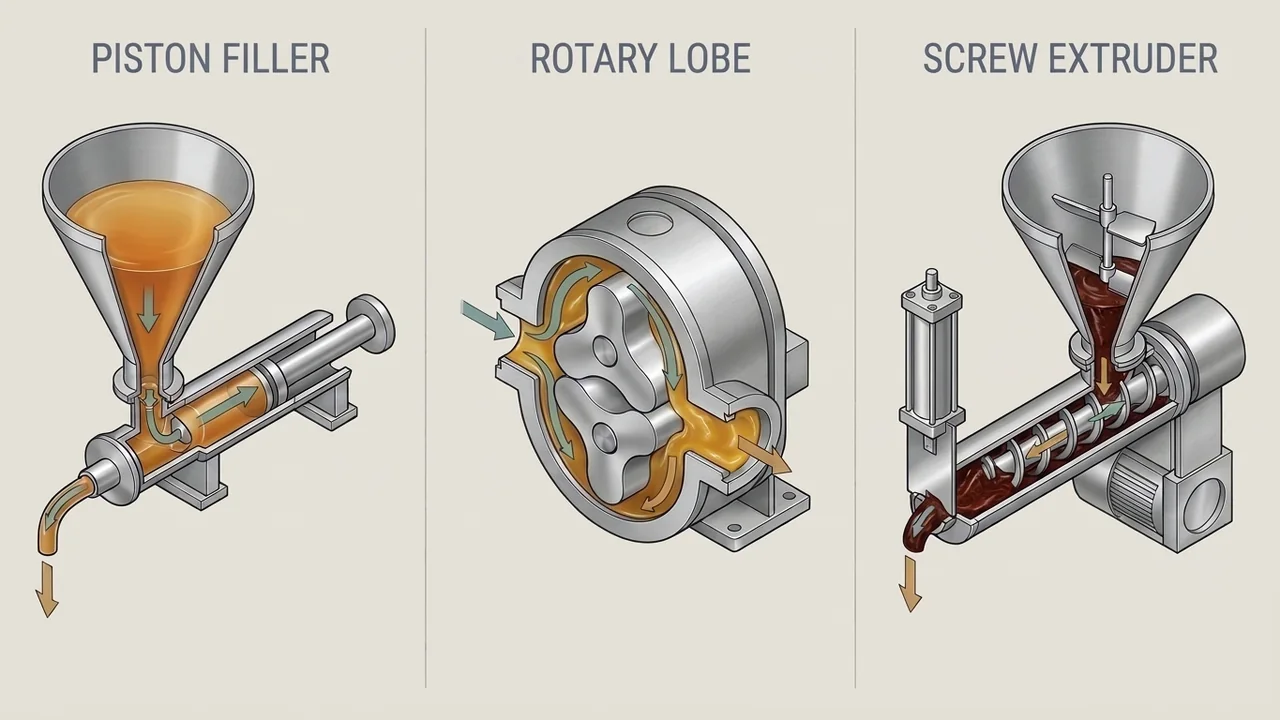
High-viscosity filling machines meter dense syrups and pastes either volumetrically, using reciprocating piston cylinders, non-contacting rotary lobe pumps, or helical progressing cavity stators, or gravimetrically under OIML R 61-1:2017 using multi-stage automatic feeding modules, load receptors, automatic tare balancing, and preset mass cut-off controls.
How Do Piston, Rotary Lobe, and Progressing Cavity Pumps Compare?
A piston pump uses a reciprocating high-pressure seal to move viscous media and solid-bearing mixtures across wide operating pressures without losing flow rate. In a force-pump cycle, the suction stroke draws product through an inlet valve into the cylinder and the discharge stroke pushes it out through an outlet valve, arranged as either single-acting (one active stroke direction) or double-acting (both stroke directions active). As DTM Packaging notes, piston filling machines deliver high volumetric accuracy on viscous products, though volumetric cylinders dispense fixed volume rather than mass when temperature shifts fluid density, take up more floor space than overflow units, and require manual disassembly and scrubbing of cylinders and valves during product changeovers.
A rotary lobe pump conveys slurries, pastes, and liquids around the interior of its casing with output that stays relatively independent of process pressure changes. External timing gears in the gearbox keep the lobes from touching each other and keep shaft support bearings out of the pumped liquid, though high-viscosity liquids require reduced pump speeds, commonly reductions to 25% of rated speed and lower, to load cavities satisfactorily.
A progressing cavity pump pairs a helical rotor with a twin-helix elastomer stator hole at twice the wavelength, creating fixed-size overlapping cavities that meter viscous or shear-sensitive pastes with minimal pulsation. Because transverse sliding contact between rotor and stator relies on hydrodynamic lubrication from the pumped medium, operating dry causes rapid stator deterioration, whereas a sufficiently viscous slurry maintains a lubricating film around suspended particles.
When Does OIML R 61-1 Gravimetric Weighing Outperform Volumetric Pumps?
Under OIML R 61-1:2017, an automatic gravimetric filling instrument (AGFI) fills containers from bulk (including liquid material) with a predetermined, virtually constant mass using automatic feeding devices paired with weighing modules, control devices, and discharge devices. In OIML R 61-1:2017 construction definitions, the feeding device supplies bulk product in one or more stages, the feed control device regulates feed rate, and the final feed cut-off device governs cut-off so average fill mass matches the preset target.
Gravimetric weighing solves two chronic failure modes in sticky molasses production:
- Un-agitated sticky batches experience syrup separation (bleeding) as heavy molasses drains toward the bottom of the hopper over a shift, shifting bulk density from wet, heavy early packs to dry, light late packs unless batches are pre-homogenized and turned over periodically.
- Sticky residue builds up on weighing buckets and chutes over a run, so OIML R 61-1:2017 clause 3.3.5.1 defines additive or subtractive tare devices, including automatic tare devices that zero load receptors without operator intervention, which we pair on LV-SY weighers with programmed automatic tare checks every N cycles and dimpled or PTFE-lined contact surfaces.
Under OIML R 61-1:2017, accuracy classes for AGFIs must be specified for intended usage, covering the nature of the product weighed, installation and operating environment, target fill mass, and rated operating conditions.
| Viscous Dosing Architecture | Primary Metering Principle | Target Product & Solids Profile | Operating Speed & Process Constraint | Cleaning & Changeover Profile |
|---|---|---|---|---|
| Volumetric piston filler | Reciprocating cylinder stroke between inlet and outlet valves | Homogeneous thick syrups, pastes, and compatible particulate slurries | High-pressure volumetric accuracy; volume-based fills vary in weight if batch density shifts with temperature | Enclosed cylinders, seals, and valves require manual disassembly and scrubbing between flavors |
| Rotary lobe pump | Non-contacting lobes timed by external gearbox gears | Pastes, slurries, and larger soft solids such as cherries and olives | Gentle low-shear flow; high-viscosity fluids commonly require derating to 25% of rated speed and lower | Sanitary casing interior with shaft bearings isolated inside the external gearbox |
| Progressing cavity pump | Helical rotor sealing inside a twin-helix elastomer stator | Viscous or shear-sensitive pastes and lubricated particulate slurries | Low-pulse cavity displacement; operating without fluid (run dry) causes rapid elastomer stator deterioration | Stator elastomer wear increases on abrasive media; unequal-walled stators pass larger solids |
| Screw extrusion & AGFI gravimetric feeder | Positive belt, rotary, or screw propulsion into load-cell weigher or block cutter | Wet, interlocking long-cut shisha tobacco soaked in molasses and glycerine | Multi-stage feed rate control, automatic tare checks every N cycles, and pneumatic cut-off gates | Open-access hoppers and removable PTFE-lined or dimpled chutes on semi-auto LV-SY units strip down rapidly |
Which Valve and Feed Designs Protect Leaf Fibers and Solids?
Protecting suspended solids and long-cut tobacco leaves requires matching internal clearances to particle shape: rotary lobe pumps with external timing gears and unequal-walled progressing cavity stators pass discrete soft solids in liquid pastes, while wet shisha tobacco uses anti-bridging hoppers, positive belt, rotary, or screw propulsion, and pneumatic cut-off gates.
In liquid food and fruit-paste pumping, non-contacting rotary lobes handle larger particle sizes without crushing discrete solids such as whole cherries or olives. On progressing cavity pumps, stators are built in equal-walled and unequal-walled geometries; unequal-walled stators place thicker elastomer peaks along the housing so the wall distorts under pressure to let larger solids pass, whereas equal-walled stators hold constant wall thickness for higher pressure per stage and precision.
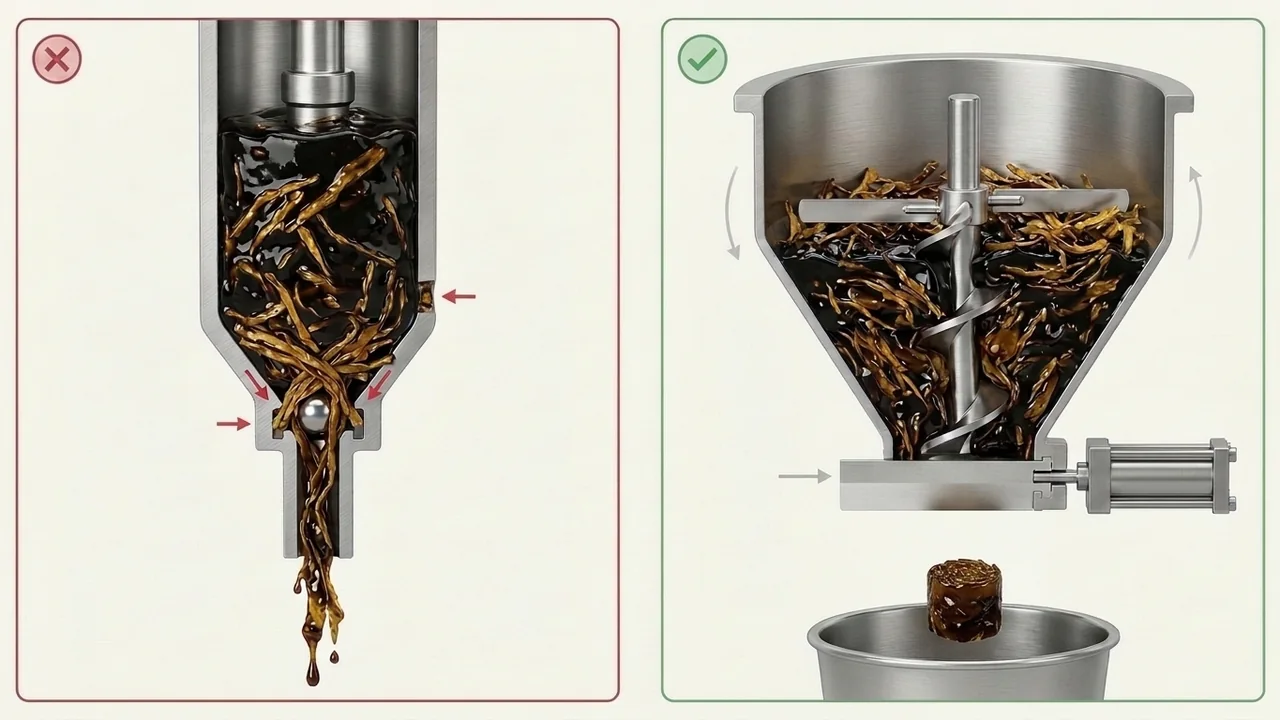
Wet hookah tobacco presents a different mechanical challenge because flexible, syrup-soaked leaf strands interlock rather than floating as isolated spheres. Without controlled hopper agitation, wet cut leaf bridges across conical throats, while aggressive dry augers shred long-cut leaves. On our LV-SY semi-automatic weighing series and roll-film extruders (such as the 80 L hopper on the LV-350SY Horizontal Flow Wrapper), controlled anti-bridging hopper agitation keeps tobacco feeding evenly into gentle positive belt, rotary, or screw propulsion channels, followed by a pneumatic cut-off gate at the discharge exit.
How Do Cut-Off Gates and Diving Funnels Prevent Seal Leaks?
A 2–4 g clump of wet leaf hanging on a nozzle lip makes one pouch 3 g underweight and the next pouch 3 g overweight while contaminating inner PE or CPP sealant layers, so paste filling and sealing machines combine pneumatic scraper gates, diving pouch funnels, or aluminum-foil induction sealing.
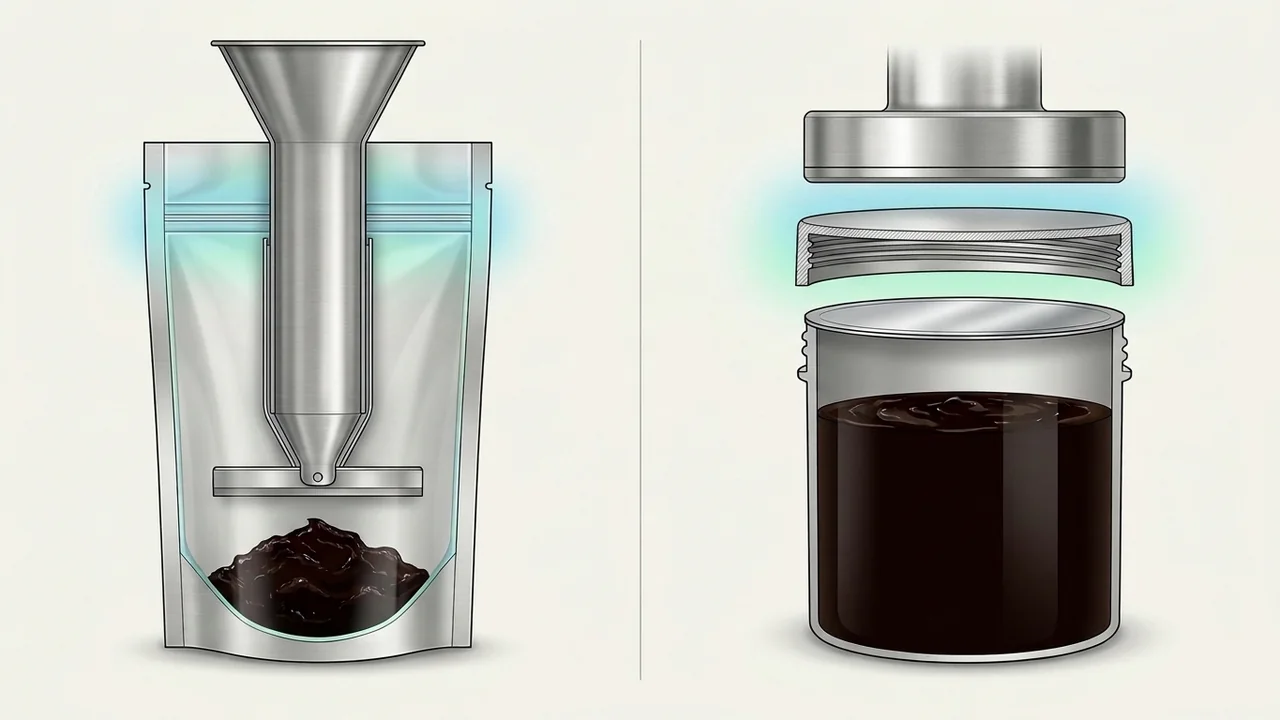
As detailed in our shisha pouch sealing troubleshooting guide, molasses, vegetable glycerine, or stray tobacco fibers landing on the inner PE or CPP sealant layer before heat jaws close is the primary cause of flexible pouch leaks. Preventing both weight error and seal-seam weeping requires isolating the seal band across every pack style:
- Discharge nozzle scraping: A pneumatic cut-off blade or mechanical scraper gate right at the nozzle exit shears trailing tobacco strands and stops syrup strings immediately once target weight is reached.
- Premade zipper pouch shielding: On the LV-350SY Pre-Made Pouch Shisha Packaging Machine, a dedicated screw/extrusion or rotary dosing head pairs with a diving funnel that shields both the zipper track and upper seal band while product drops, retracting only after its mechanical cut-off gate closes.
- Rigid tub and jar sealing: On the seven-station Hookah Bottle & Tub Filling Line, Station 03 meters dry blends by auger or wet shisha molasses via sticky-paste extrusion or piston dosing into indexed containers, followed by Station 04 screw capping and Station 05 aluminum-foil induction sealing to prevent syrup leakage.
When Should a Plant Upgrade to an Automatic Viscous Filling Machine?
Plants running 10 to 30 shisha flavors per shift favor semi-automatic LV-SY load-cell weighers covering 50–1000 g or 1000–2500 g because open hoppers and removable chutes clean rapidly, whereas sustained single-flavor batches justify automatic LV-350SY pouch wrappers, LV-320SY vertical VFFS machines, or seven-station rigid tub filling lines.
Changeover downtime often governs the boundary between semi-automatic and fully automatic viscous dosing. Enclosed piston fillers can require lengthy manual disassembly and internal scrubbing between flavors, whereas craft shisha producers switching across 10 to 30 distinct aromas rely on open-access hoppers and removable contact chutes on semi-automatic LV-SY stations to scrape out residual leaf and wipe syrup surfaces quickly. Once individual SKUs run long enough per shift to amortize washdown time, automatic pouch, roll-film, or rigid-container lines consolidate dosing and hermetic closing into a continuous cell:
| Equipment Configuration | Portion Weight Window | Rated Speed & Hopper / Line Scope | Footprint (L × W × H) & Power Supply | Best-Fit Production Scenario |
|---|---|---|---|---|
| LV-SY Single Semi-Auto Weigher | 50–1000 g | Operator-triggered load-cell feed; 250 kg machine weight | 1307 × 872 × 1614 mm; 220V, 50/60Hz, 1.5 kW | Craft producers running 10 to 30 flavors per shift into retail tubs or pouches |
| LV-SY Double Semi-Auto Weigher | 1000–2500 g | Dual-lane load-cell weighing; 500 kg machine weight | 2328 × 844 × 1614 mm; 220V, 50/60Hz | Hookah lounge bulk packs and wide-range multi-SKU batch weighing |
| LV-350SY Pre-Made Pouch Machine | 100–500 g (up to 350 mm pouch width) | 10–20 bags/min with diving funnel and cut-off gate | 4799 × 779 × 1450 mm; 220V, 50/60Hz, 2.4 kW | Automated stand-up and zipper pouches requiring clean PE or CPP seal bands |
| LV-320SY Vertical VFFS Machine | 20–100 g (80–240 mm L × 50–150 mm W) | 10–25 bags/min with top-mounted dosing hopper | 1185 × 935 × 1245 mm; 220V, 50Hz, 3.2 kVA | Small single-session roll-film sachets with positive mechanical feed |
| LV-350SY Horizontal Flow Wrapper | 100–500 g (up to 350 mm film width) | 50–120 bags/min from an 80 L extrusion hopper | 1417.5 × 750 × 1290 mm; 220V, 50/60Hz, 2.4 kW | High-speed inner pillow blocks feeding downstream checkweighing and cartoning |
| Hookah Bottle & Tub Filling Line | Matched to rigid tub or jar SKU | Seven stations: unscrambling, indexing, Station 03 dosing, Station 04 screw capping, Station 05 foil sealing | Configured to container diameter and height on GA drawing | Automated wide-mouth plastic tubs and jars with tamper-evident foil liners |
What Drives Viscous Filling Machine Price Across Pump and Hopper Options?
Viscous filling machine investment depends on five engineering configuration variables rather than a flat catalog rate: automation tier, primary pack architecture across roll-film, premade pouches, or rigid tubs, sticky-paste dosing head design, number of SKU change-part sets, and downstream checkweighing, foil sealing, cartoning, and cellophane overwrapping scope.
As outlined in our shisha packing machine price and quotation guide, purpose-built screw extruders, rotary feeders, precision piston or lobe pumps, and LV-SY sticky-product load-cell weighers carry higher mechanical engineering content than dry-granule volumetric cups because they add agitated hoppers, PTFE-lined or dimpled contact surfaces, automatic tare routines, and pneumatic cut-off hardware. Before shipping any viscous dosing system, validate the exact configuration through our sample testing and Factory Acceptance Test (FAT) workflow using the specification checklist below:
| Specification Item | Engineering Data to Confirm Before Quotation & FAT | Why It Governs Machine Selection |
|---|---|---|
| Fluid rheology & temperature window | Dynamic viscosity benchmark (such as 2,000–10,000 cP honey-grade syrup at 20 °C vs non-Newtonian paste) and filling temperature | Determines tube pressure requirement, pump speed derating (down to 25% and lower on lobe pumps), and batch pre-homogenization |
| Suspended solids & leaf cut profile | Homogeneous syrup, discrete soft particulates, or interlocking long-cut shisha tobacco leaves | Separates volumetric piston, rotary lobe, and unequal-walled progressing cavity pumps from wide-throat screw extrusion and LV-SY belt/screw weighing |
| Hopper anti-bridging & bleeding control | Agitated hopper volume (such as 80 L on LV-350SY Horizontal), periodic batch turnover, and auto-tare interval every N cycles | Prevents conical throat bridging, shift-long syrup separation, and sticky tare buildup on load cells |
| Anti-drip cut-off & seal isolation | Pneumatic cut-off blade or scraper gate, LV-350SY diving funnel for zipper pouches, or Station 05 foil induction sealing for tubs | Eliminates 2–4 g hanging leaf clumps that cause 3 g pack-to-pack weight swings and PE or CPP seal leaks |
| Pre-shipment FAT validation batch | 5–15 kg of representative wet product (or agreed non-nicotine molasses simulant) tested across 30 to 50 consecutive finished packs | Verifies actual packs per minute, calibrated checkweigher mean weight and standard deviation, and reject-gate timing |
Frequently Asked Questions
How do centipoise (cP) and millipascal-seconds (mPa·s) compare when specifying a viscous filler?
One centipoise (cP) equals exactly 1 SI millipascal-second (mPa·s). Water at 20 °C has a dynamic viscosity of about 1 cP, whereas honey at 20 °C sits around 2,000–10,000 cP, and non-Newtonian pastes require testing across actual shear rates rather than relying on a single static number.
Why can volumetric piston fillers show weight variation across a shift even when stroke volume stays constant?
Piston fillers meter containers by swept cylinder volume rather than mass. Because liquid viscosity and density shift with temperature changes over the day, and un-agitated molasses batches can separate inside a hopper, equal dispensed volumes can weigh differently unless paired with batch homogenization or OIML R 61-1 gravimetric weighing and downstream checkweighing.
Why are rotary lobe pumps run at reduced speed on high-viscosity syrups and pastes?
Because rotary lobes do not make metal-to-metal contact and have lower suction loading capability on thick media, high-viscosity liquids require reduced pump speeds, commonly reductions to 25% of rated speed and lower, so paste fills the casing cavities completely on each revolution.
Can a progressing cavity paste filler run empty during hopper changeovers?
No. Transverse sliding contact between the helical metal rotor and twin-helix elastomer stator depends on hydrodynamic lubrication from the pumped paste; allowing a progressing cavity pump to run dry causes rapid stator deterioration.
How much product is needed to validate a viscous shisha filling machine during FAT?
Pre-shipment Factory Acceptance Testing (FAT) uses 5–15 kg of representative wet shisha (or an agreed non-nicotine molasses simulant with identical cut and viscosity) to log mean weight, standard deviation, and reject-gate timing across 30 to 50 consecutive finished packs on a calibrated checkweigher.
Sources
- OIML R 61-1:2017 — Automatic Gravimetric Filling Instruments, Part 1: Metrological and Technical Requirements
- Wikipedia — Viscosity (Dynamic Viscosity Units, Non-Newtonian Fluids, and Temperature Effects)
- Wikipedia — Piston Pump (Reciprocating Positive Displacement Mechanics and Valve Cycles)
- Wikipedia — Lobe Pump (Rotary Lobe Non-Contacting Mechanics, Solids Handling, and Viscosity Speed Derating)
- Wikipedia — Progressing Cavity Pump (Helical Rotor-Stator Metering, Dry-Run Lubrication, and Stator Geometry)
Configure Your Shisha Packaging Line with LINEVO Engineers
Send your shisha tobacco pack format, target gram weight, and required speed on WhatsApp to receive technical drawings, trial videos, and an itemized factory quotation, or check our RFQ preparation checklist.
Get Quote via WhatsAppBrowse all Shisha Packaging Guides