An upstream shisha processing line prepares cured tobacco leaf into a uniform, conditioned paste ready for a shisha filling machine or high-speed wrapper. Known in reference literature as muʽassel, maassel, or waterpipe tobacco, hookah shisha combines cut leaf with molasses or honeyed syrups, vegetable glycerol (glycerin), and aromatic flavorings into a cohesive, moisture-rich mixture before packaging.
Getting leaf strand length, liquid dosing ratios, vessel agitation, and sealed conditioning right upstream directly governs weight stability and seal cleanliness downstream on our shisha tobacco packaging line. Compare pack formats, portion-weight tolerances, and washdown routines across our shisha packaging buyer guides.
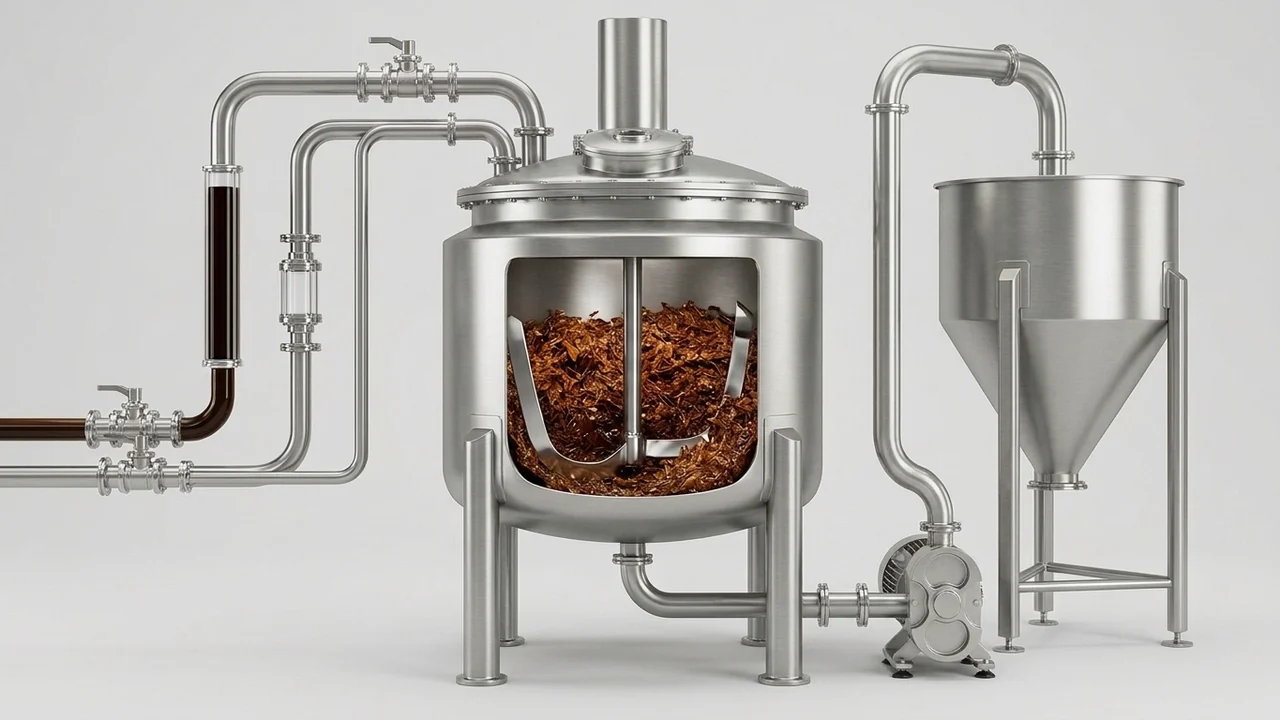
What Machines Make Up an Upstream Shisha Processing Line?
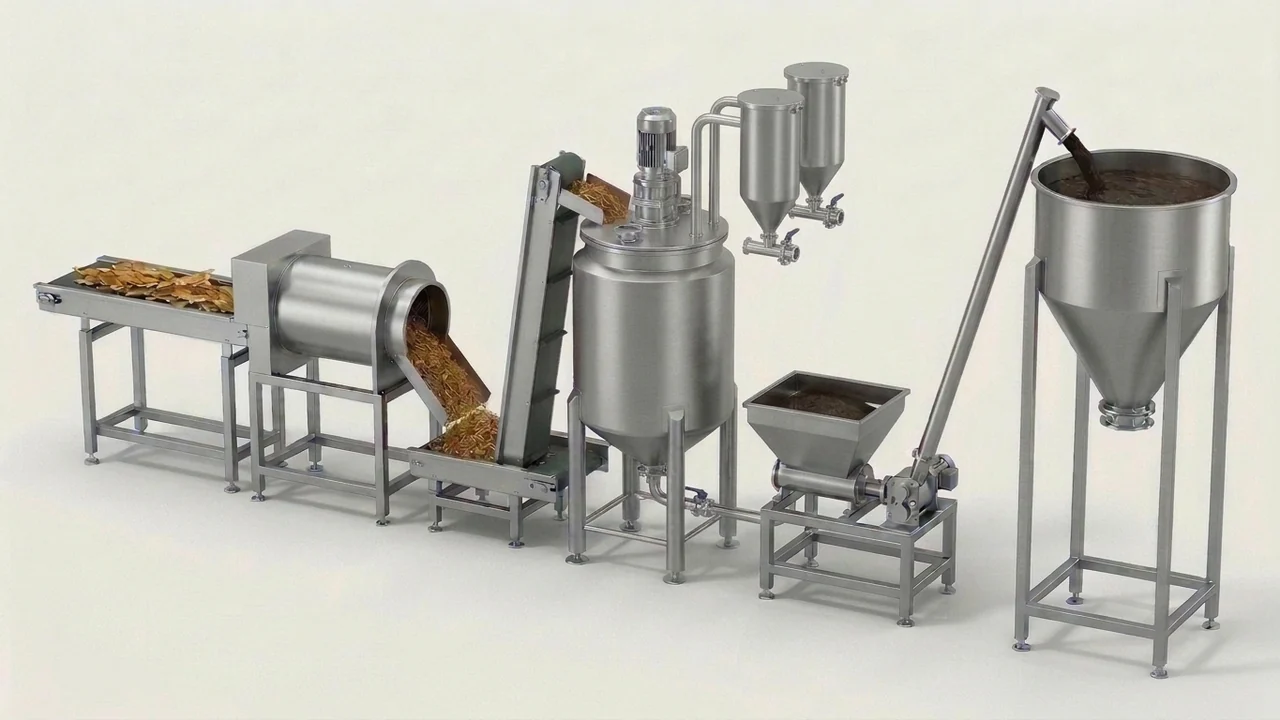
Before wet shisha paste reaches an extruder, auger filler, or weighing station, raw tobacco leaf and liquid syrups pass through six mechanical stages:
| Upstream Stage | Core Processing Equipment | Functional Role Before Packaging |
|---|---|---|
| Leaf cleaning | Vibratory screens and sorting belts | Clear stems, sand, foreign material, and loose dust from incoming cured tobacco leaves. |
| Raw-leaf grading | Multi-deck grading conveyors | Separate leaves by lamina texture, cut size, color, and moisture density so batches absorb syrup evenly. |
| Leaf size reduction | Disc shredders and cylindrical rotary cutters | Shred leaves with multi-shaft rotating discs for low dust generation, or cut leaves inside a rotary drum to a uniform strand width. |
| Ingredient metering | Volumetric flow meters and gravimetric load-cell scales | Meter warmed molasses and vegetable glycerin by volume or weigh liquid and solid inputs on load cells for exact batch ratios. |
| Paste blending | Vertical mixers, planetary mixers, and wall-scraping anchor tanks | Fold cut tobacco, sweeteners, aroma concentrates, and glycerin into a clump-free paste without crushing delicate leaf strands. |
| Downstream handoff | Rotary lobe or progressive-cavity pumps, inclined screw feeders, and stainless buffer hoppers | Transfer conditioned shisha paste at controlled flow rates into weigher pans, auger hoppers, or extruder throats. |
What Ingredients Are Blended in a Shisha Processing Machine?
Across open reference and peer-reviewed sources, waterpipe tobacco—called muʽassel or maassel (meaning honeyed), hookah, shisha, or arghile—is formulated from cured tobacco leaf, molasses or sugar/honey syrups, glycerol (vegetable glycerine), and food-grade flavorings. Wikipedia’s muʽassel and hookah entries describe marinating and fermenting cut tobacco with molasses, glycerine, and flavoring agents into a moist, pliable mixture.
In a BMC Public Health study on waterpipe tobacco preparation, Almomen et al. (2023) cite published literature showing that tobacco accounts for roughly 30% of a typical waterpipe mixture while the remaining 70% consists of flavorings, glycerol, and sweeteners. Almomen et al. (2023) note that glycerol serves as the primary humectant—retaining moisture, stabilizing batch texture, carrying volatile flavors, and generating dense aerosol clouds during heating.
From a mechanical engineering standpoint, that ~30:70 solid-to-liquid mass balance means finished shisha behaves as a sticky, high-viscosity solid-liquid suspension rather than free-flowing cut leaf. Equipment built for dry cut rag will bridge at hopper throats and coat vibratory pans within minutes; shisha processing and feeding equipment must rely on positive mechanical displacement, low-shear scraping agitation, and steep or agitated hopper walls.
How Are Tobacco Leaves Graded, Cut, Mixed, and Rested?
Consistent syrup pickup starts with clean, uniform leaf cuts. Sorting conveyors remove hard midrib stems and foreign debris, grading decks group leaves by lamina thickness, and disc shredders or cylindrical rotary cutters slice the leaf to target strand dimensions with minimal fines—since excess tobacco dust turns syrup into a stiff sludge that jams extruder screws.
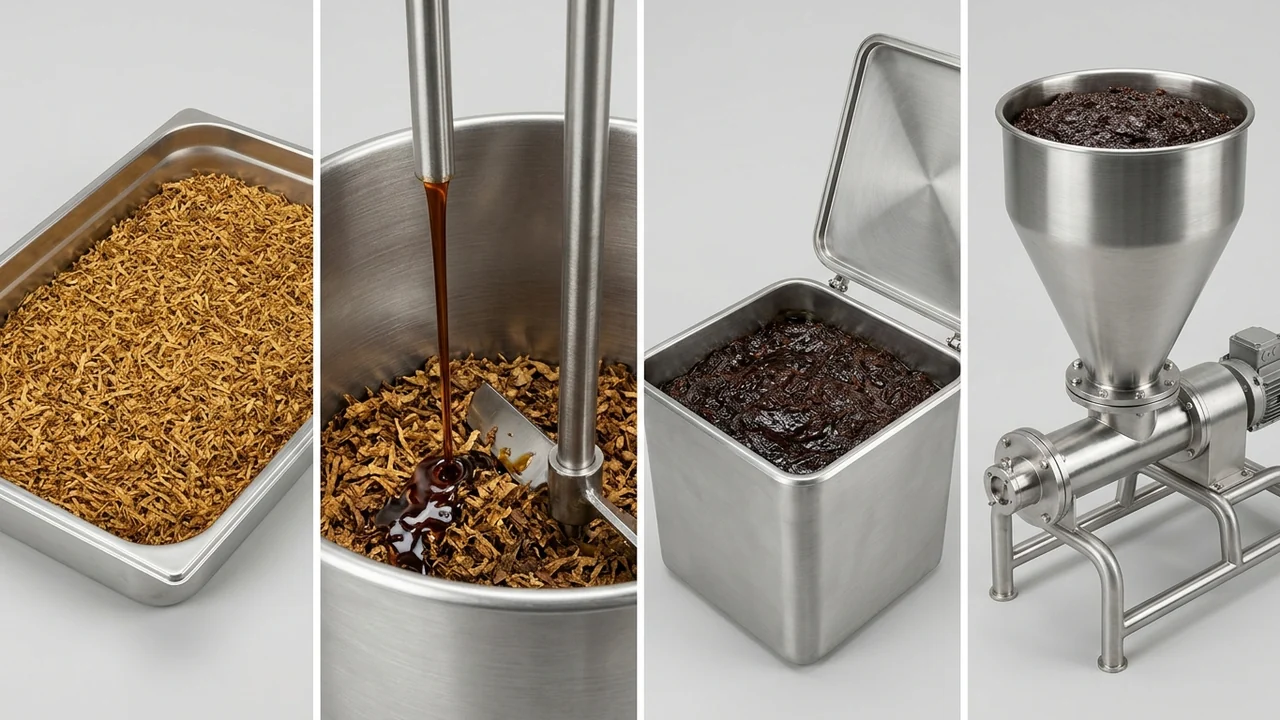
Staged liquid addition and sealed resting allow viscous sugars and humectants to penetrate the leaf cellular structure instead of pooling as free syrup at the bottom of the pack. In Almomen et al. (2023), laboratory reference batches (200 g ground raw tobacco, 300 g distilled honey or sugar, apple-aroma flavor, and glycerol) followed a five-step staged sequence:
- Even tobacco bed: Prepared raw tobacco is spread in a level layer inside the mixing container so sprayed liquids contact the entire surface evenly.
- Flavor application: Concentrated liquid aroma is sprayed thoroughly across the tobacco under continuous gentle mixing.
- Sweetener addition and 24 h sealed hold: Honey or sugar syrup is folded through the flavored leaf, and the vessel is sealed for 24 hours so sweetener softens and penetrates the leaf fibers.
- Breaking the thickened mass: After 24 hours, the sealed container is opened and the compacted, syrupy mass is gently loosened.
- Glycerol addition and homogenization: Vegetable glycerol is blended in after the initial 24-hour rest, followed in the laboratory protocol by daily remixing over 7 days to reach full sample homogeneity.
In commercial production plants, we recommend translating that staged absorption principle into a 24- to 72-hour sealed conditioning window inside lidded stainless-steel mobile totes or holding tanks:
- Spray volatile flavor concentrates and meter warmed (
40–50 °C) molasses onto the dry cut leaf first so low-viscosity aromatics and sugars soak into the lamina before heavy glycerol coats the exterior. - Fold vegetable glycerin into the batch with a slow wall-scraping anchor or planetary blade (
15–35 rpm) to coat strands without tearing long cuts. - Hold the batch in sealed stainless conditioning bins for
24–72 hoursdepending on leaf cut thickness and syrup Brix, then run a brief 5- to 10-minute re-blend to eliminate any settled bottom syrup immediately before feeding the packaging hopper.
How Should You Size Mixing Vessels to Match Packaging Line Capacity?
Sizing upstream mixers around a realistic 60–70% working vessel fill prevents dry leaf spillover at the start of mixing and keeps your downstream wrappers supplied without long idle waits or stagnant hopper loads:
| Production Tier | Recommended Mixer Type & Working Batch | Liquid Dosing & Conditioning Setup | Matched Downstream LINEVO Packaging Route |
|---|---|---|---|
Craft / Multi-SKU Pilot (50–200 L vessel; 30–120 kg wet batch) |
Open-top vertical paddle mixer or removable-bowl planetary mixer for rapid aroma washdown | Portable platform scale + interchangeable 100–200 L lidded stainless resting bins |
LV-SY Semi-Auto Weighers (50–1000 g single or 1000–2500 g double) or LV-350SY Premade Pouch Machine (10–20 bags/min, drawing 60–300 kg/hr at 100–250 g) |
Mid-Volume Plant (300–500 L vessel; 200–320 kg wet batch) |
Jacketed tank with bottom- and wall-scraping anchor agitator | Load-cell gravimetric tank weighing + mobile conditioning totes | LV-320SY Vertical Sachet Wrapper (20–100 g, 10–25 bags/min), premade pouch cells, or automatic Hookah Bottle & Tub Filling Line |
High-Speed Turnkey Line (500–1,000 L dual/triple vessels; 320–650 kg per batch) |
Staggered jacketed anchor mixers with PTFE wall scrapers + automated leaf cutters | Coriolis/gear flow meters + load-cell batching + pumped or tote-lifted feed into 80 L buffer hopper |
LV-350SY Horizontal Pillow Flow Wrapper (100–500 g, 50–120 bags/min, 80 L hopper) integrated into an 8-station or 5-station Shisha Tobacco Packaging Line |
When running a horizontal pillow wrapper at 60 packs/min on 250 g to 500 g retail blocks, Station 01 (extruder) consumes 15 to 30 kg of wet shisha per minute (900–1,800 kg/hr). Operating two or three 500–1,000 L mixing/conditioning vessels in staggered rotation ensures one tank blends and rests while a conditioned batch continuously replenishes the 80 L extruder hopper. Review full shift OEE math in our shisha packaging line capacity planning guide.
Which Stainless Steel Grades Should Contact Molasses, Glycerin, and Flavorings?
Every wetted component—dosing valves, flow meters, mixing vessel shells, scraping blades, transfer pumps, conditioning bins, and filling hoppers—contacts concentrated sugars, humectants, and volatile aroma compounds daily. Standard metallurgical classifications (summarized in Wikipedia’s stainless steel references) distinguish the three austenitic grades encountered on processing and packaging specifications:
- General stainless steel (
≥10.5%Cr): Chromium forms a self-healing passive oxide film in the presence of oxygen, providing hygienic cleanability and corrosion resistance far superior to carbon steel. - SUS304 / SAE 304: The standard austenitic chromium-nickel food-equipment alloy (
~18% Cr, 8% Ni), offering strong formability and reliable corrosion resistance against neutral syrups, vegetable glycerin, and warm-water detergent washdowns. - SAE 316 & Low-Carbon 316L: Molybdenum-bearing austenitic stainless steel (
~16–18% Cr, 10–14% Ni, 2–3% Mo) engineered for superior resistance to chloride and organic-acid pitting; the low-carbon 316L variant (≤0.03% C) prevents sensitization (grain-boundary chromium carbide precipitation) along welded tank seams.
For shisha production plants, we recommend splitting material specifications by chemical exposure rather than paying a blanket premium or risking weld corrosion:
- Specify SUS304 / SAE 304 for dry leaf sorting tables, rotary cutter housings, standard sweet-molasses and glycerin storage bins, and downstream packaging contact parts (
80 Lextruder hoppers,LV-SYweigher pans, and diving nozzles) cleaned with45–55 °Cwarm water and food-safe alcohol wipes. - Upgrade to SAE 316L for welded mixing vessels, heated syrup jackets, aroma-concentrate dosing manifolds, and positive-displacement pump rotors whenever formulations use low-pH sour citrus/berry acids, salted tobacco casings, or hot alkaline/acidic CIP sanitizers. Specify smooth ground internal welds (
Ra ≤ 0.8 µm) and food-grade PTFE wall scrapers plus replaceable EPDM or fluoroelastomer gaskets so menthol and anise oils do not linger between runs—paired with our shisha machine cleaning and flavor changeover SOP.
How Does Mixed Paste Move Into a Filling Machine?
Transferring conditioned shisha from resting vessels into the packaging hopper without squeezing free syrup out of the tobacco leaf requires matching the transfer mechanism to your plant layout and SKU changeover frequency:
- Mobile Conditioning Tote + Hydraulic Bin Lifter (Recommended for Multi-Flavor Plants): Rested
150–300 Lstainless totes roll directly from the conditioning room to a hydraulic tipper positioned above theLV-SYweigher orLV-350SY80 Lextruder hopper. Eliminating long transfer pipelines cuts flavor-changeover washdown time by 15–30 minutes and prevents residual paste loss inside pipes. - Low-Shear Rotary Lobe or Progressive-Cavity Pump: For dedicated single-flavor high-speed lines, wide-throat positive-displacement pumps push viscous paste gently from floor transfer hoppers into elevated buffer hoppers without shredding long-cut leaves. Keep pipe runs short with wide-radius sanitary bends and tri-clamp couplings for quick disassembly.
- Inclined Stainless Screw Conveyor: An enclosed auger tube with quick-open cleanout troughs lifts conditioned paste steadily into tall receiving hoppers; run the screw at low rpm with generous flight pitch so pressure does not wring liquid molasses away from the cut leaf.
At the receiving hopper, maintain paste height within a 40% to 80% fill band using ultrasonic or capacitance level sensors tied to your feeder pump or screw. Overfilling tall hoppers compacts bottom layers and forces free syrup toward the auger or extruder throat, while running below 30% causes air pockets and portion-weight drift. Explore downstream dosing architectures on our shisha filling machine page, calibrate gram tolerances with our shisha molasses filling accuracy guide, and configure secondary cartoning and 3D cellophane overwrapping on the shisha tobacco packaging line.
Buyer Handover Checklist Before Connecting Processing and Packaging
Before locking the mechanical and controls interface between your upstream processing room and downstream packaging line, align these five engineering specifications across your formulation and equipment teams:
- Leaf cut dimensions and fines limit: Confirm target strand width and length off the disc shredder or rotary drum cutter so cut leaf matches your downstream auger pitch, extruder tunnel cross-section, or diving pouch funnel opening.
- Conditioned paste rheology and free-syrup check: Standardize your
24–72 hsealed conditioning window and verify that a brief pre-pack remix leaves zero unabsorbed liquid pooling at the bin base before hopper loading. - Component-level alloy and seal schedule: Specify
SUS304on dry leaf and standard downstream hoppers,316Lwith ground internal welds on heated/welded mixing tanks and acidic flavor dosing lines, and spare PTFE/silicone seals for heavy mint or double-apple SKUs. - Batch-to-hopper mass flow balance: Match upstream batch rotation (
50–200 Lpilot mixers vs staggered500–1,000 Lproduction tanks) to your packaging consumption rate—up to900–1,800 kg/hron a60 bags/minhorizontal pillow line—and link hopper high/low level probes to the transfer feeder. - Taxpaid retail package containment: For finished goods sold in markets such as the United States, verify that primary pouches, tubs, and cartons securely contain moist pipe/waterpipe tobacco (
27 CFR 40.11) and preserve statutory marks and tax notices required before removal under 27 CFR 40.211.
Sources
- Almomen et al. (2023), Effect of Glycerol Concentration on Levels of Toxicant Emissions From Water-Pipe Tobacco Smoking (BMC Public Health, DOI) (PMC full-text mirror)
- Wikipedia — Muʽassel
- Wikipedia — Hookah
- Wikipedia — Stainless Steel
- Wikipedia — SAE 304 Stainless Steel
- Wikipedia — Marine Grade Stainless (SAE 316 and 316L)
- eCFR — 27 CFR 40.211, Package (Tobacco Products and Cigarette Papers and Tubes)
- eCFR — 27 CFR 40.11, Meaning of Terms (Pipe Tobacco and Tobacco Products)
Configure Your Shisha Packaging Line with LINEVO Engineers
Send your shisha tobacco pack format, target gram weight, and required speed on WhatsApp to receive technical drawings, trial videos, and an itemized factory quotation, or check our RFQ preparation checklist.
Get Quote via WhatsAppBrowse all Shisha Packaging Guides